1. Introduction
My current conlang, Dirnang, returns to a long-term obsession of mine with languages with small systems of finite verbs. In this post, I want to describe the semantics of the verb class I’ve settled on.
Some readers may not be familiar with such languages, but they are common in certain corners of the world, including a decent swathe of Aboriginal Australia. In such languages, the finite (light) verb provides some combination of argument structure, aktionsart, and basic force dynamics (which could be called “event type”). Because the small verb class is very generic, these verbs are then augmented by a large class of adverbial, non-inflecting complements or adjuncts which are often called “coverbs”. Together, the finite verb and coverb cover the semantic space that the open verb class of a language like English covers.
If the closed verb class has such a classificatory function, then the light verbs are not completely semantically empty, but because a small number of verbs is covering the space of all possible verbal meanings, they are very generic or bleached compared to the meanings typical of verbs in a language such as English.
2. Background on Dirnang Verbal Inflection and Verb Classes
In Dirnang, verbs inflect for the categories of mood, aspect, voice, agreement, and motion (direction and associated motion). Most of these are not especially relevant to the semantics of the verb class, but voice and motion do affect which meanings are lexicalised, and how.
2.1 The Two Voices
Dirnang verbs inflect for two primary voices, the active and the perfect. The table below summarises the differences between these two voices.
| Criterion | Active | Perfect |
| Viewpoint | Process oriented | Result oriented |
| Lexical Aspect Affinity | Durative, dynamic | Punctual, stative |
| Phasal Affinity | Preparatory, aorist | Culminatory, consequent |
| Agentivity | Unmarked (contextual) | Typically low, accidental and ability (AIA) readings available when an agent is present |
| Morphological Transitivity | Unmarked (contextual) | Morphologically explicit |
| Morphological Agreement | S/A affixes, O clitics (Nom-acc alignment) | Abs affixes, erg affixes (ergative alignment) |
| Markedness | Unmarked (for root actives) | Marked (for root actives), often mirative for agentive or transitive clauses |
| Culmination | Only implied (non-culminating accomplishments) | Required (voice profiles culmination and resultant state) |
| Most accessible intransitive reading without further marking | Reciprocal (plural subject to parallel externally oriented action), self-directed agentive process or motion | Reflexive and self-affected subject (“got dressed”), passive |
| Morphological aspect restrictions | Required in the progressive | Incompatible with progressive, although habitual is possible |
| Tense restrictions | Any, ambiguous between present and past readings | Cannot describe a dynamic present tense event due to lack of durativity. Can describe present tense states. |
As should be clear from the above, the active is a process-oriented voice. It profiles events with a dynamic and often durative phase, and is incompatible with a pure stative reading. Although it does not require agentivity, since it accepts inanimate subjects, it yields a default agentive, in-control reading when an animate agent is present. It is not a (strong) perfective form, since it is compatible with present tense events, although when it is critical to assert that an event is ongoing in parallel with another event, the progressive aspect is typically used. Nor is it imperfective, as it is the default form used to describe a sequence of dynamic events in narrative, with additional marking deployed for explicitly progressive or habitual events. It could be considered to be similar to the “narrative present” or “historical present” of other languages, except for the fact it is the default and not a marked stylistic choice.
The perfect, on the other hand, is a voice dedicated to profiling the point of state change and the resultant state. It downplays agentivity, and can only accept a transitive reading with explicit suffixal ergative agreement derived from the nominal possessive paradigm. When agentivity is present, it is often read as markedly reduced compared to use of the active voice, yielding either accidental or ability readings.
This makes the two voices similar to the control marking present in Salish and certain Austronesian languages, although there are some differences (based on my understanding of these languages).
2.2 Voice-Based Inflectional Classes
Verbs divide into two classes depending on their inherent voice: root-actives, which require derivation to appear in the perfect, and root-perfects, which natively take the perfect suffixes and completely lack active voice forms. The root-perfect class is small, but contains stative and punctual patientive verbs whose lexical aspect is incompatible with the semantics of the active.
2.3 Motion Marking
Dirnang verbs host motion specification in two morphological slots. The prefixal slot is primarily directional in nature, distinguishing meanings such as venitive, andative and distributive. When added to verbs with no inherent motion, they may also add associated motion of either the subject, object or both. Dirnang therefore falls into the class of D-AM languages, which use the same forms for both directional and associated motion meanings.
The second slot is the same slot that hosts the progressive aspect. This slot hosts an additional form which marks action mid-journey, with the approximate meaning “go along doing”, or “do while going”.
Because direction is encoded morphologically, the small class of finite verbs is lacking in motion roots that encode deixis. That is, there are no splits of the type go/come or take/bring.
3. The Verbs
3.1. General Verb Root Semantics
The “Bifurcation” thesis states that verb roots may encode manner or result, but not both, with apparent counterexamples due to inference. Without committing to the truth of this in the general case, the verbs of Dirnang systematically exclude, with one exception, the detailed description of result. Verbs encode either pure aspect (e.g. stativity) and transitivity, or they encode the high-level manner or dynamics of the event. Since verbs are manner focused, the vast majority are root-actives, with only a few high frequency roots completely bleached of manner specification.
3.2. Verb Root Classification
Roots may be phonologically classified according to whether they are a-grade or zero-grade, and according to their prosody (vowel harmony) class. However, this is outside of the scope of the current post.
Roots may be morphologically and semantically classified according to:
- their base voice
- their semantic transitivity: intransitive, transitive, or ambitransitive
- whether they require an augment to appear in the intransitive perfect
- whether the dominant reading in the intransitive perfect is middle (spontaneous) or passive (covert agent)
The latter three are correlated. Root actives can be subdivided into three broad classes:
- Strict intransitives
- Augment lexically determined
- Only middle readings available in the perfect
- Root transitives (i.e. external-directedness is part of their meaning)
- Take the augment
- Prefer passive readings in the intransitive perfect
- Ambitransitives (i.e. event can be conceptualised as self- or other-directed)
- Most typically do not take the augment
- Intransitive perfect may be ambiguous between suppressed agent and self-affectedness
3.3. Verbal Inventory by Type
| Intransitive Perfect Features | |||||
| Root | Gloss | Root Voice | Transitivity | Perfect Augment? | Reading? |
| n | BE/HAVE | Perfect | Ambitransitive | No | N/A |
| (ə)ⁿɖ | FALL | Perfect | Intransitive | No | N/A |
| ᵐbal | DIE | Perfect | Intransitive | No | N/A |
| (t)e | MOVE | Active | Intransitive | Yes | N/A |
| kʎ | CLIMB | Active | Intransitive | No | N/A |
| ɲar | RUN | Active | Ambitransitive | No | Middle |
| ⁿɟan | DRIVE | Active | Ambitransitive | Yes | Both |
| (ə)ɭɳ | FLOW | Active | Ambitransitive | No | Both |
| wlp | SCRAPE | Active | Ambitransitive | No | Both |
| mɲ | EAT | Active | Ambitransitive | No | Middle |
| jᵐb | SEE | Active/Perfect | Ambitransitive | No | Both |
| pr | THROW | Active | Ambitransitive | No | Both |
| ⁿgl | BIND | Active | Ambitransitive | No | Both |
| cp | BURN | Active | Ambitransitive | No | Both |
| ma(ɻ) | HANDLE | Active | Transitive | Yes | Passive |
| (t)o | GIVE | Active | Transitive | Yes | Passive |
| kʷ | HIT | Active | Transitive | Yes | Passive |
| kʷc | PRESS | Active | Transitive | Yes | Passive |
| eɭ | CARRY | Active | Transitive | Yes | Passive |
| ɲk | POKE | Active | Transitive | Yes | Passive |
| neɳ | CHOP | Active | Transitive | Yes | Passive |
| ᵐboc | CURSE | Active | Transitive | Yes | Passive |
3.4. Detailed Description of Verbal Semantics
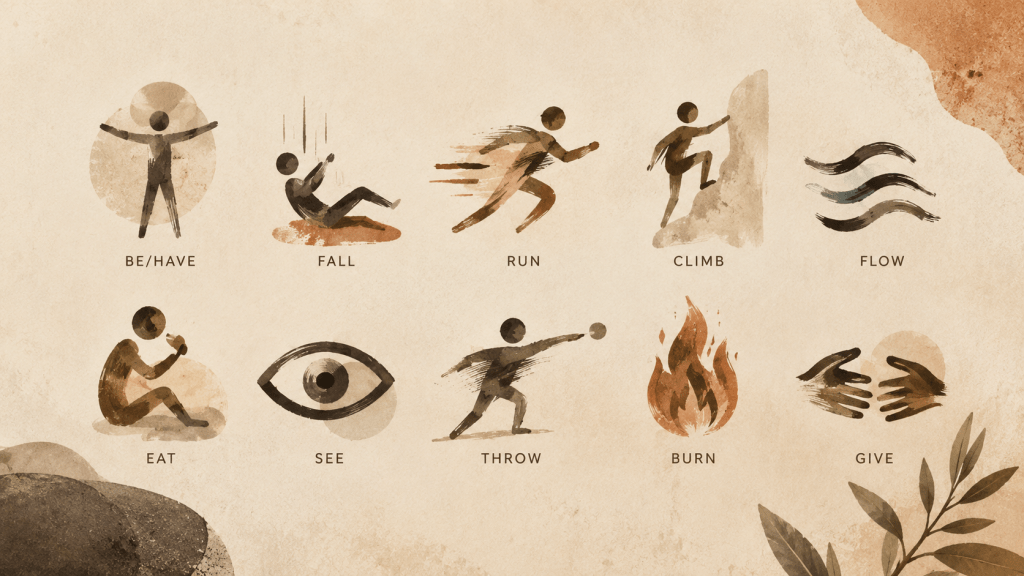
BE/HAVE
English translations: be(come), exist, be at, have, have/keep object in a state
BE/HAVE is a pure stative operator, with little additional semantics. When inflected as an intransitive perfect, it ascribes a location or property to the subject. When inflected as a transitive (i.e. with the ergative/possessive indices), it indicates that the subject owns the object or experiences a state ascribed to the object.
Inchoative readings for this root are available by implication, but entry into the ascribed state is not an inherent part of its meaning.
FALL
English translations: fall, arrive, appear, become
FALL is a punctual inchoative operator. It describes a state of affairs where the subject enters into a new state, without profiling any kind of agentivity or build-up on the part of the subject. The state which is ultimately arrived at is typically non-gradeable, i.e. the change being described involves boundary-crossing.
FALL events often “just happen” from the point of view of the speaker. FALL therefore selects events which are portrayed as either non-durative, or as the natural culmination or risk of the pre-existing state of affairs (e.g. fall dead, fall ill).
The boundary-reaching or -crossing aspect of its meaning gives it motion senses of fall (arrive at ground), arrive (enter location), appear (enter visual range). Because fall requires a hard boundary and does not profile a build-up, it resists use with motion that typically requires work, such as upwards motion (climb, fly up, …). FALL is also the normal verb to describe being born, one of the ultimate boundary crossing human acts.
DIE
English translations: break (itr.), die, stop, cease
DIE describes events where the subject ceases to function.
DIE is the most specific resultative verb of all, and the exception to the rule that Dirnang verbs do not describe specific outcomes. Because of its specificity, DIE collocates with a very limited range of coverbs, and is used as a stand-alone verb relatively more frequently than almost any other.
MOVE
English translations: move, do, act, go, come, work, become
MOVE describes the subject performing a dynamic action which primarily affects its own bodily configuration or location. The root itself is agnostic as to whether this action is in place, or involves movement between locations. This difference is conveyed via directional prefixes: without a prefix the reading is typically in-place, whereas the addition of a venitive or andative marker yields “go” or “come” readings. MOVE may also express inchoative and state change situations, like FALL or BE, but in the case of MOVE the change is achieved via continuous change and the resultant state is generally gradable and even reversible.
MOVE splits the semantic range covered by “do” in other languages. MOVE may cover intransitive activities, like “do a dance”, but systematically excludes transitive, other-directed activities, which co-locate with other verbs instead.
CLIMB
English translations: climb (up), fly (up), ascend
CLIMB involves the subject using its own energy or momentum to ascend, without external causation. Like DIE, it is one of the more specific verbs, and primarily collocates with manner of motion or path coverbs.
RUN
English translations: run, make go
RUN, like move, is primarily an intransitive, self-directed activity verb, but with the addition of a (fast) speed component. However, it does permit a transitive causative reading in the context of activating or using moving machinery.
DRIVE
English translations: ride (animal), drive (vehicle), push (object), drive (cattle)
In its transitive use, DRIVE implies that the subject and the object travel together along the same trajectory, and that the subject induces the object to move but does not transport it on their person (see: CARRY). In its intransitive use, it yields a middle reading where the subject travels in an implicit vehicle, or a passive meaning that the subject is induced to move by an implicit agent.
FLOW
English translations: flow, pour, fly, swim, slide, glide, blow, sail
FLOW involves low-friction motion along a trajectory. This motion may be either within a medium (flying in the air, swimming in the water), or along a surface (slide). It is compatible with either causative motion of this type, or self-induced motion. Interestingly, it also extends to sailing, where one travels in a boat with the environment (air) providing the source of energy. When travelling along a surface, it contrasts with high-friction SCRAPE.
SCRAPE
English translations: scrape, sand, rub, knead, whittle, peel, brush, dig
SCRAPE involves action against friction along a surface, or movement along a surface that is difficult in some other sense. The action in question is often repetitive and prolonged. In its transitive use, it covers a wide array of traditional activities including aspects of food preparation, woodwork, digging etc. In its intransitive use, it also covers difficult or awkward self-directed motion such as crawling.
EAT
English translations: eat, drink, suck, take inside, consume
EAT is the consumption verb, and covers the subject taking the object into its own body, most typically via the mouth. Consumption is not actually necessary, as some coverbs only require that the object enters the mouth, and not that it is destroyed. In its intransitive form, the patient is normally suppressed, with passive meanings (“get eaten”) being marked and often favouring other verbs instead. EAT does not classify biting, which is instead associated with CHOP.
SEE
English translations: see, hear, know, learn
SEE describes perception at a distance (touch and taste are typically classified with other verbs). It is also the verb most comfortable alternating between the active and perfect transitive paradigms, with little markedness in either case. In the perfect, it describes passive perception (“see”, “hear”), whereas in the active directed attention is required (“look”, “listen”). Because learning is typically by observation, the same verb extends to knowledge. The intransitive perfect tends to be middle-oriented “able to see”, with “appear”, “be seen” classified instead with other verbs like FALL.
THROW
English translations: throw, drop, free, release, let, loose, explode, pop, give birth
THROW is glossed based on the Australianist tradition, but its meaning here is less about ballistics than about release. The event profile of THROW is that, after an optional build-up (for example, accelerating the object), the subject releases the object to leave their sphere. The subsequent trajectory is less relevant or undirected. In this sense, THROW contrasts with GIVE or the violence verbs (HIT, PIERCE, …), which describes a directed transfer of energy or an object to a target. The fact that this verb does not require either violent action or the discarding of the object is shown by the fact that it classifies giving birth, which is an act of separation without any ballistics or negative connotations.
When used in an intransitive sense, the subject releases internal pressure, often suddenly and in a self-destructive way. This motivates the use of THROW for coverbs covering explosion and popping, as well as some undirected and involuntary sound making events like cry, whimper, scream and so on.
BIND
English translations: close, bind, seal, tie, …
BIND is in some sense the opposite of THROW, since it describes some form of enduring connection being established between the target object(s). The associated coverb then specifies what form of connection is meant. This connection may be either physical or social (marriage, friendship, …).
When used intransitively, the subject spontaneously closes or seals itself, or is induced to do by a covert agent.
BURN
English translations: heat, cook, warm, burn (tr.), burn (itr.)
BURN describes the action of heating an object, or the object spontaneously becoming warm. Unlike the English gloss, it does not require any specific temperature or transformation threshold, only that action is via heat.
HANDLE
English translations: manipulate, put, do, use, get, receive
HANDLE is hard to gloss, because it is one of the most frequent verbs, and in many cases is simply the default verb for induced change or motion of an object. Often, events described by handle are durative, i.e. they describe activities or accomplishments. HANDLE also covers the initial acquisition phase of taking an object into the subject’s sphere, which may be glossed as “get”.
When contrasted with other manner of action verbs, HANDLE describes actions performed by manipulation with the hands or action in place via direct physical contact, and not action at a distance, by weight or by an instrument.
GIVE
English translations: give, transfer, emit
GIVE involves the directed transfer of an object or property from the subject’s sphere into the sphere of a target entity. That transfer may be positive or negative for the recipient. Sometimes violence may be involved, although violent physical action normally selects a different classifier like HIT, PIERCE or CHOP. Given the lack of a generic DO or SAY verb, GIVE is also the verb of choice for directed communication (speech). And it also covers a number of other emission type events, including emission of light and odor, which unexpectedly do not always classify with THROW.
HIT
English translations: hit, strike
HIT is the least marked verb of violence. It typically involves rapid application of force to the object or a rapid movement or transformation of the object. It says little specific about the shape of the instrument, except when contrasted with POKE (end of long object) or CHOP (edge) or PRESS (by weight or momentum).
PRESS
English translations: squash, press, crush, kick
PRESS involves action against an object by the subject’s weight or momentum, or by action downwards using the bottom part of the subject’s body. In this latter sense, it may sometimes mean “kick” or “act with feet”, although kicking is also associated with HIT. Often, the action is durative and gradable.
CARRY
English translations: bring, take, carry, maintain, keep, wear (clothing)
CARRY is a durative verb that involves literal or metaphorical induced motion of the object with the subject. While it may be telic (taking an object to somewhere), CARRY may also describe actions that are sustainable indefinitely.
POKE
English translations: poke, pierce, stab, spear, shoot
POKE involves action with the end of an elongated instrument, or of a small projectile on an elongated trajectory (e.g. a bullet). POKE does not require that the object is pierced, even if contact is achieved, as the gloss “poke” suggests. It only requires action by a tip along an elongated path.
CHOP
English translations: chop, cut, bite, gnaw, chew, slash
CHOP involves action by an edge, or by grinding between two edges. It may involve cutting or separation, but as for POKE, the verb does not require that the object is damaged, only that an edge acts on the surface of the object. The instrument may either by a cutting or hitting instrument (knife, axe, sword, whip, …) or, in the case of the body, most typically the teeth.
CURSE
English translations: curse, condemn, judge, insult
CURSE is another case where the English gloss is more specific than the current meaning. While CURSE has its origin in magical effect at a distance, its modern sense entails only that the object is affected in a non-physical and non-visible way, and that the effect is negative. Thus, it extends to insults and rumours, but also social or institutional actions like being fined, losing a court case, or being sentenced to prison. It also extends to secret malicious action such as poisoning.
4. Some Recurring Semantic Distinctions
This section contains some notes on recurring semantic distinctions which may not be obvious from the descriptions above.
4.1. Spheres of Influence
Certain distinctions can be conceptualised in terms of transfer of control over an object. HANDLE involves the subject taking an object into their physical control and then acting on it. THROW involves the subject releasing or expelling an object from their sphere. GIVE involves the subject transferring an object or status to an external target sphere.
4.2. Friction and Surface Contact
Certain pairs contrast in terms of resistance of the object or medium to motion:
- FLOW (low friction) vs SCRAPE (high friction)
- CARRY (object is on subject’s body and does not resist) vs DRIVE (object is often in contact with the ground and may be independently powered)
4.3. Speed and gradability of change
The most obvious example of this is BE(COME) and FALL, which do not normally express incremental gradable change, and MOVE, which does. However, the transitive manner of motion verbs also show a similar distinction, with HIT and POKE typically expressing semi-punctual change, whereas HANDLE often describes gradual manipulation.
5. Verb – Coverb Semantic Domain Mapping
This is a provisional description of recurring verbs by coverb semantic domain. These domains are based on recurring domains of description in grammars such as Meakins’ and McConvell’s grammar of Gurindji.
As the following lists make clear, the most frequent verbs in Dirnang are BE/HAVE, MOVE, HANDLE, GIVE and HIT.
5.1 State
- BE/HAVE – default stative verb
- MOVE – some states that require active maintenance, often with the sense of “temporarily become” or “stay”
5.2. Static Spatial Configuration
- BE/HAVE – to describe the static state of affairs
- FALL – to describe entry into the state without any manner description
- MOVE or CLIMB – to describe entry into, or maintenance of, an unstable or high energy state, or one that involves upward motion
- HANDLE – as the unmarked “put” verb
5.3. Transfer
- GIVE – targeted transfer to another person
- THROW – untargeted release of object
5.4. Holding
- HANDLE – easily movable object, especially held in hands or arms
- CARRY – object held by body, or held while subject is in motion
5.5. Speech and Sound Emission
- GIVE – deliberate speech or noise aimed at a recipient
- THROW – some involuntary sounds (screams, whimpers, cries)
- CURSE – judgements, insults, social or institutional harm
5.6. Bodily Function
- EAT – consumption
- FALL – be born, fall ill
- MOVE – bodily motion, some high energy emotions
- CARRY – some persistent bodily or emotional states
- THROW – release from body (urinate, defecate, spit, give birth)
- SEE – seeing, hearing, knowing etc.
- DIE – death
5.7 Motion and Induced Motion
- MOVE, DRIVE, FLOW, … – manner of intransitive, many also allowing induced motion readings
- FALL – spontaneous arrival or entry into locative stative
- HANDLE (“put”) – minimal transitive manner specification when combined with directional coverbs
- CARRY – motion of object supported by the body of the subject
5.8. Cooking
- BURN – actions involving application of heat
- SCRAPE – grinding up ingredients, kneading dough etc.
5.9. Impact and Intensity
- HIT – most generic violence verb
- POKE – impact via end of instrument or elongated path
- CHOP – biting or cutting action
- PRESS – stomping or crushing action, sometimes kicking
5.10 Touch and Manipulation
- HANDLE – most generic verb for manipulation with hands
- SCRAPE – repeated action along a surface (including rubbing)
- HIT – classifies some reaching or touching coverbs
5.11 Emission and Environmental Conditions
- GIVE – steady transfer of light etc. to perceiver
- THROW – uncontrolled release or explosions
- HIT – environmental or external effect on object (e.g. “storm hit”)
6. Comparison with Australian Languages
Since it was inspired by Australian languages, the Dirnang inventory shares many features in common with these languages. Most of the most frequent meanings documented by McGregor in his typological work are here, including statives (BE), FALL (punctual spontaneous state change), manner of violence (HIT, POKE, CHOP), induced motion (CARRY, THROW), and acquisition (HANDLE, GIVE). Verbs like SEE, EAT, and BURN/COOK are also relatively common.
However, compared to the Australian languages cited in section 7, the chosen verb inventory for Dirnang diverges in certain ways. Two of the most notable are:
- Lack of a DO/SAY or generic atelic verb
In many Australian languages, the single most frequent verb is one that covers both durative activities and speech. Dirnang lacks such a verb, and instead splits this category between MOVE (intransitive do) and GIVE (communication or emission), with the residue scattered amongst the other transitive categories.
- Lack of a dedicated GO verb
Dirnang lacks a GO verb dedicated to translational motion. The MOVE verb covers both GO and intransitive DO, with the difference marked via directional prefixes or path coverbs.
- Presence of manner of motion distinctions
Most Australian languages with small verb classes, to the extend they have multiple intransitive motion verbs, are verb-framed. Motion contrasts in their inventory either encode deixis (COME/GO), or path (ENTER/ARRIVE/…). By contrast, Dirnang has a small set of verbs encoding manner of motion, and leaves path and deixis to either other verbal morphology or to coverbs. This is more similar to the Algonquian pattern, since Algonquian finals (which are the primary marker of argument structure and therefore the “light verbs” of the Algonquian verbal word) may encode manner, whereas path is encoded by the initial.
- Additional manner of action verbs
Some of the manner of action verbs like SCRAPE, BIND, PRESS and CURSE are not common (or even attested?) in Australian small, closed verb classes. Most classes have some class that covers action by body weight, but its scope may not match PRESS. Gurindji does have a verb for action by witchcraft, but its scope appears to be much narrower than CURSE in Dirnang.
7. Sources and References
My primary sources are grammars and studies of Australian Aboriginal languages. These include:
- Verb Classification in Australian Languages, by William McGregor
- The Nyulnyul language of Dampier Land, Western Australia, by William McGregor
- A Grammar of Warlmanpa, by Mitchell Browne
- Murrinhpatha Morphology and Phonology, by John Mansfield
- A Grammar of Gurindji, by Felicity Meakins and Patrick McConvell
- Simple and Complex Verbs in Jaminjung, by Eva Schultze-Berndt
There were also some sources describing Australian languages with larger or open verb classes, but which nevertheless had similar light verb or complex verb constructions:
- Ngiyambaa, by Tamsin Donaldson
- A Grammar of Kunbarlang, by Ivan Kapitonov
Outside of Australia, sources on languages with similar closed (light) verb classes include:
- Nishnaabemwin Reference Grammar, by J. Randolph Valentine
- The Structure of Karam, by Pawley
The following references were also useful:
- Verbs: Aspect and Causal Structure, by William Croft
- The Roots of Verbal Meaning, by John Beavers and Andrew Koontz-Garboden


Leave a Reply