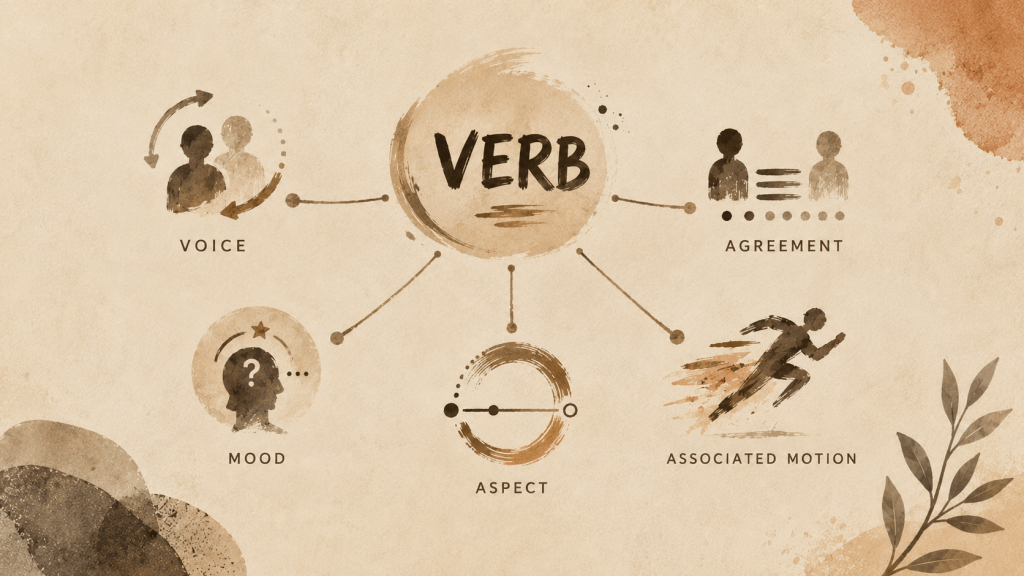
Full disclosure: I wrote this myself without AI assistance as a LaTeX document (since I create pdf grammars using LaTeX), but I did use ChatGPT to do the format conversion from LaTeX to WordPress compatible HTML. I also used ChatGPT to generate an image to go with this article.
The most complicated element of the clause in Dirnang is the verb phrase, and the most morphologically complex part of the VP is the verb itself. This chapter therefore focuses entirely on the morphology and distinctions expressed with the verbal word.
The basic template is as follows:
(augment) – (directional) – root – (extension) – (erg.agr) – voice+mood+subj.agr
All verbs take an overt suffix that marks a combination of grammatical voice, mood, and agreement. Other slots are optional in the sense that they need not be filled by an overt morpheme, but the ‘optional’ slots often fill cells in the core inflectional paradigms. The augment is a critical part of the agreement paradigm, which distinguishes certain speech act participants from third persons. The extension slot contains mutually exclusive voice and aspectual suffixes.
1. Semantic Oppositions Within The Paradigm
1.1. Voice
Dirnang verbs mark two voices, the active and the perfect, which show distinctive suffix paradigms. Roots can be divided into two basic voice classes depending on whether they can occur in both voices (the “root actives”), or only in the Perfect (the “root perfects”). Table 1 summarises the semantic and functional difference between the voices.
| Criterion | Active | Perfect |
|---|---|---|
| Viewpoint | Process oriented | Result oriented |
| Lexical aspect affinity | Preparatory, aorist | Culminatory, consequent |
| Agentivity | Unmarked, contextual | Typically low, accidental and ability (AIA) readings available when an agent is present |
| Morphological transitivity | Unmarked, contextual | Explicit |
| Affixal agreement controller | Subject | Polypersonal, ergative and absolutive |
| Markedness | Unmarked (for root actives) | Marked (for root actives), often mirative for agentive or transitive clauses |
| Most accessible intransitive reading without further marking | Reciprocal (plural subject to parallel externally oriented action), self-directed agentive process or motion | Reflexive and self-affected subject (“got dressed”), passive |
| Morphological aspect restrictions | Required in the progressive | Incompatible with progressive, although habitual is possible |
| Tense restrictions | Any, realis is ambiguous between present and past readings | Cannot describe a dynamic present tense event due to lack of durativity. Can describe present tense states. |
The Active is a process-oriented voice. It profiles events with a dynamic and often durative phase, and is incompatible with a pure stative reading. Although it does not require agentivity, since it accepts inanimate subjects, it yields a default agentive, in-control reading when an animate agent is present. It is not a (strong) perfective form, since it is compatible with present tense events, although when it is critical to assert that an event is ongoing in parallel with another event, the progressive aspect is typically used. Nor is it imperfective, as it is the default form used to describe a sequence of dynamic events in narrative, with additional marking deployed for explicitly progressive or habitual events. It could be considered to be similar to the “narrative present” or “historical present” of other languages, except for the fact it is the default and not a marked stylistic choice.
The Perfect, on the other hand, is a voice dedicated to profiling the punctual point of state change and the resultant state. It downplays agentivity, and can only accept a transitive reading with explicit suffixal ergative agreement derived from the nominal possessive paradigm. When agentivity is present, it is often read as markedly reduced compared to use of the active voice, yielding either accidental or ability readings.
It is important to understand, however, that the perfect is not just a passive. It is true that root active verbs are more marked in the perfect, and their perfect forms typically show passive, accidental action, or ability readings. But the passive is only one reading amongst several, and then there is the fact that a perfect transitive paradigm exists, and that there is the class of verbs which only occur in the perfect.
1.2. Transitivity
The transitivity of a verb is determined by a combination of the stem’s inherent transitivity, the inflectional suffixes which are present, and the syntactic context, namely the presence of an object clitic or object noun phrase in the clause. In cases where stems are ambitransitive, inflection dominates in the Perfect, whose paradigm consistently marks transitivity, whereas syntactic context is the only available cue in the Active voice, whose endings are transitivity neutral.
1.3. Agreement
Verbs always agree with their subject (A/S), and Perfect transitives also agree with their object. However, the mapping of roles to slots is not one-to-one, as the outer affixes (augment and final suffix) are used for subject agreement in the Active but for absolutive agreement in the Perfect.
| Voice | Augment + Outer Suffix | Inner Suffix |
|---|---|---|
| Active | S/A | – |
| Perfect | S/O | A |
1.4. Mood
Verbs show a consistent distinction between realis and irrealis forms. The realis can be used to refer to any past or present event that the speaker presents as real, specific, and localisable to a point in time. The irrealis covers all other categories, including future, habitual, negative, imperatives and other deontic senses, and counterfactuals. Given the large semantic range of the irrealis, the exact meaning is often narrowed by clausal elements outside of the verbal word.
1.5. Direction and Associated Motion
Verbs may take one of three prefixes to orient the motion of a participant in the course of the action being described. The prefixes are limited to general deictic notions (hither, thither, in various places), and do not provide detailed path descriptions, which are instead delegated to coverbs, verbal complements and prepositional obliques. The moving entity is ambiguous between subject, subject and object, and object alone, and if a verb has no inherent motion or translocational semantics, use of the prefix adds associated motion semantics to the predicate. This makes these prefixes D-AM markers in the terminology of Associated Motion, edited by Antoine Guillaume and Harold Koch.
2. Verb Roots
Verb roots may be phonologically classified according to whether they are a-grade or zero-grade, and according to their prosody (vowel harmony) class. However, this is outside of the scope of the current post. Vowel alternations due to prosody are discussed in chapter “Word Phonology”, and therefore this will not be revisited here.
Morphologically and semantically, verb roots may be classified according to:
- Their root voice
- Their semantic transitivity: intransitive, transitive or ambitransitive
- Whether they show stem modifications in the Perfect intransitive
- The typical reading of the Perfect intransitive as spontaneous (middle) or externally caused (passive)
The latter three are correlated. Stem modification in the perfect occurs most frequently with transitive active roots, and it is precisely this class that typically has passive readings in the intransitive perfect. Outside of this group, the presence of perfect stem change is infrequent and either arbitrary or present for phonological repair such as hiatus resolution.
The full set of verb roots and their perfect stems are given in table 3, in both IPA and in the standard orthography. Note, however, that orthographic forms may be affected by affixation, especially when it comes to the spread of rounding from affixes as described in chapter “Word Phonology”. There is also some additional irregularity for move, give, handle, scrape and see which will be dealt with in subsequent sections.
| Perfect Intrans. | ||||||||
|---|---|---|---|---|---|---|---|---|
| Gloss | Transitivity | Root Voice | Root | Prosody | ND Stem | NG Stem | N Stem | Reading |
| be/have | Ambitransitive | Perfect | n <n> | a | – | – | – | – |
| fall | Intransitive | Perfect | (ə)ⁿɖ <ird> | a | – | – | – | – |
| die | Intransitive | Perfect | ᵐbal <bal> | a | – | – | – | – |
| move | Intransitive | Active | (t)(e) <(t)(e)> | e | eⁿd <ed> | eⁿg <eg> | en <en> | – |
| climb | Intransitive | Active | kəʎ <cilh> | a | – | – | – | – |
| run | Ambitransitive | Active | ɲar <nharr> | a | – | – | – | Both |
| drive | Ambitransitive | Active | ⁿɟan <ghan> | a | ⁿɟaⁿd <ghad> | ⁿɟaⁿg <ghag> | ⁿɟan <ghan> | Both |
| flow | Ambitransitive | Active | (ə)ɭɳ <irln> | o | – | – | – | Both |
| scrape | Ambitransitive | Active | wəlp <ûlp> | o | – | – | – | Both |
| eat | Ambitransitive | Active | məɲ <minh> | a | – | – | – | Middle |
| see | Ambitransitive | Active | jəᵐb <îb> | a | – | – | – | Middle |
| throw | Ambitransitive | Active | pər <pirr> | a | – | – | – | Both |
| bind | Ambitransitive | Active | ⁿgəl <gil> | a | – | – | – | Both |
| burn | Ambitransitive | Active | cəp <chip> | e | – | – | – | Both |
| handle | Transitive | Active | ma(ɻ) <ma(r)> | a | maⁿɖ <mard> | maɻⁿg <marg> | maɳ <marn> | Passive |
| give | Transitive | Active | (t)o <(t)o> | o | oⁿd <od> | oⁿgʷ <og(u)> | on <on> | Passive |
| hit | Transitive | Active | kʷ <c(u)> | o | kʷəⁿd <cud> | kʷəⁿgʷ <cug(u)> | kʷən <cun> | Passive |
| press | Transitive | Active | kʷəc <cuch> | a | kʷəcəⁿd <cuchid> | kʷəcəⁿg <cuchig> | kʷəcən <cuchin> | Passive |
| carry | Transitive | Active | eɭ <erl> | e | eɭⁿɖ <erld> | eɭⁿg <erlg> | eɭⁿɖ <erld> | Passive |
| poke | Transitive | Active | ɲək <nhic> | a | ɲəkəⁿd <nhicid> | ɲəkəⁿg <nhicig> | ɲəkən <nhicin> | Passive |
| chop | Transitive | Active | neɳ <nern> | e | neⁿɖ <nerd> | neɻⁿg <nerg> | neɳ <nern> | Passive |
| curse | Transitive | Active | ᵐboc <bʷoch> | o | ᵐbʷocəⁿd <bochid> | ᵐbʷocəⁿg <bochig> | ᵐbʷocən <bochin> | Passive |
3. Regular Person+Voice+Mood Paradigms
There are four regular inflectional paradigms for verbs, but no verb can take more than three. These are:
- Active,
- which is compatible with all root active verbs
- Intransitive Perfect,
- which is available to all verbs, but using one of two root-selected paradigms:
- Bare Intransitive Perfect,
- which involves direct suffixation of voice+mood+agreement suffixes
- Derived Intransitive Perfect,
- which involves an additional nasal derivational suffix and a modified set of final suffixes
- Transitive Perfect,
- which is only available to verbs which are transitive or ambitransitive
Phonemic and orthographic versions of these paradigms are given in tables 4, 5, 6 and 7. As always, the symbol A represents a low vowel whose exact quality is determined by the prosody class of the root. It is important to note that rounding harmony can affect the shape of the morphemes. For example, the root /kʷ/ <cu> is an o-prosody root, so when the suffix /Aⁿɖəmən/ <-Ardimin> is added, the result is /kʷoⁿɖəmʷən/ <cordumun>, not *<cuordimin>.
In table 5, the derived paradigm uses labels stemnd, stemng and stemn for the perfect stem forms given in table 3. A verb which lacks these stem forms takes the bare paradigm instead.
A general feature of the Dirnang verbal paradigm is that the same form can often mark different categories depending on which ‘slot’ it occupies in the word, and which paradigm it occurs in.
| Subject Person | Realis | Irrealis |
|---|---|---|
| 1sg | A-root-Aj <-Aî> | A-root-j <-î> |
| 3f | root-Aj <-Aî> | root-j <-î> |
| 2sg | A-root-Aɻ <-Ar> | A-root-cəj <-(i)chî> |
| 3m | root-Aɻ <-Ar> | root-cəj <-(i)chî> |
| 1pl | A-root-AmA <-AmA> | A-root-məj <-(i)mî> |
| 2/3anim.pl | root-AmA <-AmA> | root-məj <-(i)mî> |
| Bare Paradigm | Derived Paradigm | |||
|---|---|---|---|---|
| Absolutive Person | Realis | Irrealis | Realis | Irrealis |
| 1sg | A-root-w <-û> | A-root-kəj <-(i)cî> | A-stemnd-w <-û> | A-stemng-j <-î> |
| 3f | root-w <-û> | root-kəj <-(i)cî> | stemnd-w <-û> | stemng-j <-î> |
| 2sg | A-root-k <-(i)c> | A-root-kəɻ <-(i)cir> | A-stemng-w <-û> | A-stemng-ɻ <-ir> |
| 3m | root-k <-(i)c> | root-kəɻ <-(i)cir> | stemng-w <-û> | stemng-ɻ <-ir> |
| 1pl | A-root-mən <-(i)min> | A-root-kəməj <-(i)cimî> | A-stemn-məw <-(u)mû> | A-stemng-məj <-(i)mî> |
| 2/3anim.pl | root-mən <-(i)min> | root-kəməj <-(i)cimî> | stemn-məw <-(u)mû> | stemng-məj <-(i)mî> |
| Ergative Person | ||||
|---|---|---|---|---|
| Absolutive Person | 1sg | 1pl | 2 | 3 |
| 1sg | A-root-A-ʎ-A <-AlhA> | A-root-A-ⁿɟ-A <-AghA> | A-root-A-ⁿɖ-A <-ArdA> | A-root-A-ʈ-A <-ArtA> |
| 3f | root-A-ʎ-A <-AlhA> | root-A-ⁿɟ-A <-AghA> | root-A-ⁿɖ-A <-ArdA> | root-A-ʈ-A <-ArtA> |
| 2sg | A-root-A-ʎ-ək <-Alhic> | A-root-A-ⁿɟ-ək <-Aghic> | A-root-A-ⁿɖ-ək <-Ardic> | A-root-A-ʈ-ək <-Artic> |
| 3m | root-A-ʎ-ək <-Alhic> | root-A-ⁿɟ-ək <-Aghic> | root-A-ⁿɖ-ək <-Ardic> | root-A-ʈ-ək <-Artic> |
| 1pl | A-root-A-ʎ-mən <-Alhmin> | A-root-A-ⁿɟ-əmən <-Aghimin> | A-root-A-ⁿɖ-əmən <-Ardimin> | A-root-A-ʈ-əmən <-Artimin> |
| 2/3anim.pl | root-A-ʎ-mən <-Alhmin> | root-A-ⁿɟ-əmən <-Aghimin> | root-A-ⁿɖ-əmən <-Ardimin> | root-A-ʈ-əmən <-Artimin> |
| Ergative Person | ||||
|---|---|---|---|---|
| Absolutive Person | 1sg | 1pl | 2 | 3 |
| 1sg | A-root-A-ʎ-əj <-Alhî> | A-root-A-ⁿɟ-əj <-Aghî> | A-root-A-ⁿɖ-əj <-Ardî> | A-root-A-ʈ-əj <-Artî> |
| 3f | root-A-ʎ-əj <-Alhî> | root-A-ⁿɟ-əj <-Aghî> | root-A-ⁿɖ-əj <-Ardî> | root-A-ʈ-əj <-Artî> |
| 2sg | A-root-A-ʎ-əɻ <-Alhir> | A-root-A-ⁿɟ-əɻ <-Aghir> | A-root-A-ⁿɖ-əɻ <-Ardir> | A-root-A-ʈ-əɻ <-Artir> |
| 3m | root-A-ʎ-əɻ <-Alhir> | root-A-ⁿɟ-əɻ <-Aghir> | root-A-ⁿɖ-əɻ <-Ardir> | root-A-ʈ-əɻ <-Artir> |
| 1pl | A-root-A-ʎ-məj <-Alhmî> | A-root-A-ⁿɟ-əməj <-Aghimî> | A-root-A-ⁿɖ-əməj <-Ardimî> | A-root-A-ʈ-əməj <-Artimî> |
| 2/3anim.pl | root-A-ʎ-məj <-Alhmî> | root-A-ⁿɟ-əməj <-Aghimî> | root-A-ⁿɖ-əməj <-Ardimî> | root-A-ʈ-əməj <-Artimî> |
3.1. Voice Marking
There is no single overt marker for the active or the perfect. Voice is marked as a gestalt from the verb form’s inflectional paradigm, including the choice of mood marking and person agreement. To the extent voice markers can be isolated, the most overt independent marking of voice belongs to the perfect: some verbs do carry a nasal extension in the intransitive perfect, and the transitive perfect consistently contains a suffix /-A-/ that precedes the person and mood marking.
3.2. Mood Marking
There is no consistent marker for either of the moods. In the active, the realis is marked by /-A-/, and the irrealis by /-j/. In the perfect, the irrealis is marked by either /-k/, or by selection of the irrealis person forms {j, ɻ, məj}, or both.
3.3. Person Marking
The primary person paradigm, which agrees with the subject in the active and the absolutive in the perfect, is circumfixing. The suffix set does not mark any speech-act participant (SAP) distinctions, but only distinguishes masculine, feminine and animate plural. SAPs are added into the paradigm by means of the augment prefix /A-/, which descends historically from a cislocative form. This prefix splits a historical 1sg-3f and 2sg-3m homophony, yielding the following combinations:
augment + 3f → 1sg
augment + 3m → 2sg
augment + anim.pl → 1pl
While the augment has a stable shape, the outer agreement suffixes show a significant degree of allomorphy. The feminine suffix set {j, w, A} is vocalic in nature, whereas the masculine set {k (≈ⁿg), ɻ, c} favours consonants. The animate plural set {m, mən, məj, məw} consistently includes a bilabial nasal. The exact allomorph used depends on transitivity, voice and mood. The detection of these suffixes is complicated by the fact that the same forms also encode voice or mood, and by metathesis driven by a general preference for glides to occur on the periphery of the word. /-k/ marks perfect irrealis forms, /-w/ marks the derived perfect realis, and /-j/ marks the irrealis.
When it comes to the ergative suffixes of the transitive perfect paradigm, the structure becomes much more transparent. There is a clear and consistent association of 1sg: /ʎ/, 1pl: /ⁿɟ/, 2: /ⁿɖ/ and 3: /ʈ/. The ergative suffix paradigm is also reduced compared to the absolutive, as it lacks both gender and number outside of the first person.
3.4. Position and Shape of the Augment
There is an additional complication when it comes to the augment, given that Dirnang both forbids hiatus and dislikes trapped glides. These constraints produce three rules that determine the shape of the augment:
- Schwa deletion
- A schwa is deleted after the augment, i.e. /Aə/ → /A/
- W Coalescence
- In o-prosody words, /ow/ triggers glide deletion and coalescence, giving /o/.
- Glide Metathesis
- When a sequence /AjC/ or /AwC/ occurs, the glide and low vowel are reordered to give /jAC/ and /wAC/. This notably affects the verb see.
The final constraint violation in this class is when an underlying sequence /A-A/ occurs, which is limited to the roots move and give. In this case, /t/ is inserted to separate the two low vowels. However, this /t/ historically belonged to the verb root, and therefore this may be better treated as a case of root allomorphy than a property of the augment itself.
4. Irregular Verbs
There are a small number of especially irregular verbs. These are:
move
move, one of the highest frequency irregular verbs, has two main irregularities. The first is that in the active, it is basically rootless, and marked only by e-prosody. The second is that a historical onset consonant t is restored after a low prefix vowel in certain forms. The full paradigm is given in table 8.
| Active | Perfect | |||
|---|---|---|---|---|
| Person | Realis | Irrealis | Realis | Irrealis |
| 1sg | eteî | etî | etedû | etegî |
| 3f | eî | î | edû | egî |
| 2sg | eter | echî | etegû | etegir |
| 3m | er | chî | egû | egir |
| 1pl | eteme | emî | etenmû | etegimî |
| 2/3anim.pl | eme | mî | enmû | egimî |
give
give shows two irregularities in the active. The first is that, like move, an epenthetic -t- appears when the root o- is directly preceded by a low vowel. The second is that it shows an irregular stem or- in the active irrealis. These rules make its paradigm look somewhat like move, but whereas the vowel of move is weak, the root vowel of give is strong and never deletes.
| Active | ||
|---|---|---|
| Person | Realis | Irrealis |
| 1sg | otoî | otorî |
| 3f | oî | orî |
| 2sg | otor | otorchî |
| 3m | or | orchî |
| 1pl | otomo | otormuî |
| 2/3anim.pl | omo | ormuî |
scrape
scrape is only irregular because the initial glide is weak. Not only is it lost after the augment (see section “Position and Shape of the Augment”), but it is also lost when a directional prefix precedes the root. Thus ûl-ûlp → ûlilp- and irrA-ûlp → irrolp- .
see
see is also irregular due to its initial glide. When the augment is added, metathesis instead produces A-îb- → îab- (see section “Position and Shape of the Augment”). When a directional prefix ending in /A/ is added, the same metathesis process applies, giving /ngA-îb/ → ngîab- and /irrA-îb/ → irrîab-, but /ûl-îb/ → ûlîb-.
handle
Irregularities in handle are restricted to the active, and relate to the dropping of the coda /ɻ/ in certain forms. The active paradigm is given in table 10. The perfect is regular given the perfect intransitive stem forms in table 3.
| Active | ||
|---|---|---|
| Person | Realis | Irrealis |
| 1sg | amaî | amarî |
| 3f | maî | marî |
| 2sg | amar | amarchî |
| 3m | mar | marchî |
| 1pl | amarma | amarmî |
| 2/3anim.pl | marma | marmî |
5. Directional Prefixes
| Form | Directional Meaning | AM Meaning |
|---|---|---|
| ŋA- <ngA-> | hither, this way, here | come and, come while |
| wəl- <ûl-> | thither, off, away, over there, elsewhere | go and, go and do elsewhere |
| ərA- <irrA-> | all over, all around, here and there | go around doing |
There are only three directional prefixes, which are listed in table 11 above. Since none of the verb roots are dedicated deictic motion verbs, these prefixes are very frequent, especially in combination with move. Ngeteî (← ngA-(t)eî), for example, is the normal way of saying ‘she came’. Note that move and go both restore their erstwhile onset -t- when addition of a directional would create a sequence of two low vowels. Since the augment precedes the directional prefix, any augment-stem irregularity is blocked. Thus engeteî is ‘I came’.
6. Progressive Suffixes
6.1. The Plain Progressive
There are two post-root suffixes which derive progressive forms. -îA- is the normal progressive, which requires a root compatible with the active voice, and only takes active endings. Due to vowel coalescence, the progressive neutralises mood contrasts in the 1sg and 3f forms.
| Person | Realis | Irrealis |
|---|---|---|
| 1sg/3f | -îAî | -îAî |
| 2sg/3m | -îAr | -îAchî |
| anim.pl | -îAmA | -îAmî |
In the progressive, the most irregular verbs have forms move: (t)eîe-, give: (t)oîo-, and handle: marîa-. All other verbs are regular.
6.2. The Ambulative
The ambulative encodes that the subject performed the action while travelling, and usually performed it more than once. It also has metaphorical extensions that don’t involve physical travel, yielding translations like ‘keep on’ and ‘do too much’. Despite the ordering root-ambulative-voice, semantically the ambulative has scope over the perfect voice, so an ambulative perfect requires multiple distinct culminations, one for each subevent along the path.
The ambulative has the form -Alp, which is always affixed to the bare root. This suffix then takes the same combination of active, intransitive perfect and transitive perfect paradigms that the root is compatible with. In the intransitive perfect, -Alp always takes the bare paradigm. The major irregular verbs have forms move: (t)elp-, give: (t)olp-, and handle: marlp- /maɭp/.


Leave a Reply