Note: this text was originally written in LaTeX and then converted using an LLM to HTML for WordPress. I apologise for any formatting errors. Other than that, I used ChatGPT for review and error spotting purposes and to generate the featured image, but I wrote the original text.
Additional context: the language I am designing has a tendency towards phrasal phonological integration and dependent-head synthesis in a similar way to Coptic or Nivkh. The structure described below is the maximal verb complex that can be accommodated within a single accentual phrase (AP).
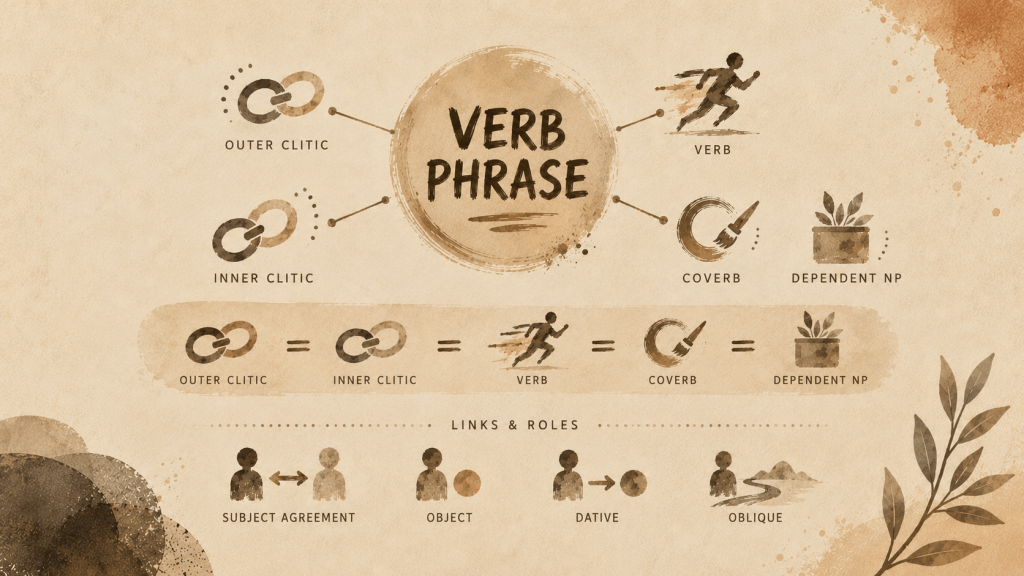
The previous chapter dealt with the structure of the verbal word itself, but the verb forms a tightly integrated phrase with several additional elements. As described in chapter Phrasal Phonology, integrated nominal and verbal phrases in Dirnang are compound-like in several respects. They show considerably more phonological integration than their English equivalents, and recursion is more restricted unless the phrase is dissolved into independent components. The integrated verb phrase has the following structure:
At the level of the VP, only the initial particle field may contain more than one element. An integrated VP may contain at most one specific dependent NP, although this restriction applies to the maximal NP: the dependent NP may itself contain recursively embedded possessors. The restriction also does not apply to bare, non-specific nominal material. Bare nouns may function as coverbs or may be compounded with other coverbs.
Consider the following example:
Although the construction contains two elements that are lexically nouns, only cucoî ‘tree’ heads a specific dependent NP. The bare noun garrat ‘axe’ does not introduce a referential axe. It occupies the coverb slot and specifies the instrument or manner of the event, producing a meaning comparable to English axe-chop. Recruitment from other lexical classes is typical of coverbs, which are defined primarily by their position and function in the integrated VP and have few distinctive morphosyntactic properties of their own.
Here too, achap ‘foot’ does not constitute a dependent NP. It is a bare noun compounded with the preceding coverb poch/puch ‘broken’. Incorporation of common nouns, especially body-part nouns, is a productive means of deriving more specific coverbs.
Complex Verb Constructions
Complex predicates are very common in Dirnang. Because the class of verbs is small and closed, they combine with verbal adjuncts called ‘coverbs’ to expand the range of event types that can be described. Before getting into the detailed semantics of the Complex Verb Construction (CVC) and how a verb and coverb are composed, it is helpful to describe at a very high level what each contributes and what the whole then becomes.
Verbs, as described in the Verbal Morphology chapter, mostly lexicalise or morphologically mark a combination of argument structure, agentivity (‘unergative’ or ‘unaccusative’), lexical aspect, and general manner or force dynamics. However, since there are only 22 verbs, not all combinations of values along these dimensions can be fully and unambiguously elaborated by the verb itself. Further, the detailed outcomes of events are barely encoded in the verb class at all, with the exception of die and burn.
This leaves three major functions for coverbs: further elaboration of manner, modifications to argument structure, but above all encoding of the result of an action. Many coverbs have stative semantics for precisely this reason. And when a coverb and a verb combine, the result is normally a recognisable action type. ‘Scrape clean’ is a good CVC because wiping down a surface to clean it is an instantly recognisable action type. But ?‘scrape big’ would be a very odd CVC, unless assigned some idiomatic, non-compositional meaning, because it’s hard to imagine what typical cultural action that could refer to.
Coverb Types
In Dirnang, ‘coverbs’ are the class of non-referential items commonly used as a complement or adjunct to a finite verb. Despite the name, it is arguable whether coverbs constitute a word class or not, since they have been recruited from a number of sources and fall into a number of distinct semantic types:
- Monadic property
- Stage-level “fall ill”
- Individual-level “be tall”
- Relational property or path “go in(side)”
- Event modifier “go limping”
- Participant-oriented depictive “carry piggyback”
- Incorporands used to saturate a semantic role
- Incorporated theme nouns “see sights”
- Incorporated adjuncts “chop axe”
- Incorporated inanimate cause nouns “(be) lightning-hit”
Because these are semantic types, they do not map directly onto morphosyntactic classes. The same coverb may be used in more than one way, for example as a monadic (resultative) property and a participant-oriented depictive. There are also simultaneous hybrids of these categories, and especially hybrids of monadic property and manner, much like English verbs ‘electrocute’ (cause death by means of electricity) or ‘shatter’ (break into small pieces by means of violent action).
However, if we focus on the idealised types, they have distinct interactions with the lexical aspect of the resulting complex verb construction (CVC) and its argument structure, and have differing productivity in relation to the verbs they combine with. At one extreme, individual-level predicates, which denote highly time-stable states, mostly combine with be and perhaps one or two other verbs. On the other hand, some event modifying and stage-level coverbs are highly productive and can combine with many different verbs in a semantically transparent and regular way. The table below summarises the typical behaviour of the different coverb types.
| Coverb Type | Semantic Target | Aktionsart Restrictions and Effect | Valency Effect |
|---|---|---|---|
| Individual-level property | participant | supplies a characterising property; dynamic combination normally requires scalar/change coercion |
none |
| Stage-level property | participant | supplies an episodic state; may become a result state with change-of-state verbs |
none |
| Relational property | participant + Ground/Goal | may supply a bounded relation, path or result |
may leave an additional Ground/Goal open |
| Depictive | participant during event | supplies a state/configuration simultaneous with the event |
none; requires an existing controller |
| Manner | event | elaborates the dynamic phase | none |
| Incorporated adjunct | instrument/location/ means etc. |
classifies event subtype or manner |
adjunct-like variable internally saturated |
| Incorporated core N | Theme | often favours activity or patientive readings |
saturates a core role and reduces syntactic valency |
A Note on Notation
This grammar does not firmly commit to any specific linguistic formalism beyond basic linguistic theory. For this section, however, it is useful to adopt a standard notation for the semantic and argument structure effects of Dirnang’s complex verb construction. The following is an example of the chosen formalism:
Here, V represents a verb, CV represents a coverb, CVC represents the resulting complex verb construction, and the letters between the angle brackets ⟨⟩ represent participant variables (typically arguments) made available for complex predicate composition. By convention, the order of the arguments is actor-like/external participant, affected/theme participant, and then any other members of the underlying argument structure, although not all may be present. In the above example, the first argument of the final CVC is a, and this corresponds with the first argument of the V.
In between the initial V+CV input and the final CVC, there is a simple pseudo-Davidsonian representation of the semantics. Parentheses () contain eventuality and semantic participant arguments, and ∧ represents conjunction. The eventuality argument comes first and is separated from the participants by a semicolon. RESULT and DURING are special predicates that relate eventualities to each other. Therefore, the example above means that:
- The verb and coverb both have two underlying arguments, which are unified such that the second argument b of V is unified with the first argument c of CV. The resultant CVC has three slots in its argument structure.
- The CV denotes a state or relation, but in this particular construction, the nature of the V and CV coerces a state change interpretation of the CV, whereby the state event s follows causally from the verbal event e.
Now compare this example, of an incorporation construction:
The same notation is used here, but with some additional elements. N represents a coverb of nominal origin, and because incorporated nouns are predicative instead of referential, it also takes a participant argument. ∃, the existential operator, introduces and binds a new variable and asserts the existence of some corresponding entity satisfying the predicate, without leaving the variable as an open argument of the CVC. Finally, OBLIQUE(e;c) is a predicate asserting that c occupies an oblique role in event e. OBLIQUE is a convenient meta- or archi-predicate that represents a more specific, contextually determined, predicate like LOCATION, INSTRUMENT, CAUSE and so on.
It is important to take care when thinking about the truth value of any of the above in the context of verbal semantics. The complex predicate is used in the context of inflectional and contextual modality which may place the truth value of the entire predicate within an alternative or counterfactual world, and not reality. This means, for example, that ∃ does not assert that an entity satisfying the proposition exists in the real world, only the world in which events e and s occur.
Rules of Predicate Composition
This section lays out the productive, compositional rules when verbs and coverbs are combined. However, it must be reiterated that complex verb constructions are subject to lexicalisation, and are frequently non-compositional to some degree. Idiomatic CVCs are simply entries in the lexicon, and are not required to obey the rules.
Argument Unification
Where the CV is stative, regardless of its semantic valency, it is normally predicated of the verb’s most affected participant. For an intransitive verb this is its sole argument, whereas for a transitive verb it is the theme argument. Combinations where a stative specifies the configuration of the most agent-like argument of a transitive verb are marginal and lexicalised. That is, if we neglect the temporal sequencing, we get the following depending on the semantic transitivity of the verb:
V⟨a,b⟩ + CV⟨c⟩b=c→ V(e;a,b) ∧ CV(s;b) → CVC⟨a,b⟩
V⟨a⟩ + CV⟨b,c⟩a=b→ V(e;a) ∧ CV(s;a,c) → CVC⟨a,c⟩
V⟨a,b⟩ + CV⟨c,d⟩b=c→ V(e;a,b) ∧ CV(s;b,d) → CVC⟨a,b,d⟩
The cause of the much greater productivity of theme-oriented statives, including depictives, is likely that the state of the theme is much more significant to formation of a recognisable event type than incidental or simultaneous state of the agent. ‘eat (food) raw’ is a more conventional action type than ?‘eat food naked’ is. Dirnang has resources to describe a simultaneous state of the agent, but this is simply not commonly accomplished by incorporating said state into the predicate.
Interpretation of Stative Coverbs
When a coverb is a stative or a relational property, there are three possible readings: stable, depictive, or resultative. The following semantic cases apply for monadic predicates, with higher arity predicates showing generalised versions of the same patterns:
| Stable state | be⟨a⟩ + CV⟨b⟩ a=b→ CV(s;a) → CVC⟨a⟩ |
| Depictive | V⟨a⟩ + CV⟨b⟩a=b→ V(e;a) ∧ CV(s;a) ∧ DURING(e, s) → CVC⟨a⟩ |
| Resultative | V⟨a⟩ + CV⟨b⟩a=b→ V(e;a) ∧ CV(s;a) ∧ RESULT(e, s) → CVC⟨a⟩ |
Non-resultative stable state readings are extremely restricted, and almost always require the support verb be. be in this case is not a verb that brings its own semantics ‘to the table’, but simply a support element to allow stative elements to form a predicate. It is therefore absent from the semantic structure of such stable state CVCs.
The division between depictive and resultative readings is more complex, and depends on both the V and CV, as well as context. Many CVs have a strong preference for one or the other. Pure directionals, which specify the result of motion, never support a depictive reading. This may be because they are not pure states, even though they describe the result of motion, since they also encode a path and therefore a preceding change over time. On the other hand, positional CVs like ‘sitting’, ‘lying’, ‘supported on the back’ may permit either reading.
For ambiguous cases, Vs may then add their own bias. Verbs which support extended or atelic durative action readings, like carry, accept or even prefer depictive readings with compatible CVs. On the other hand, since depictives are almost always patient-oriented, and CVCs describe recognisable conventional action types, punctual telic verb readings tend to favour a resultative interpretation.
Event Modification
Pure manner coverbs are unlike stative and relational CVs because they do not contribute participants to the event structure or add a distinct subevent, and there is therefore no unification of underlying participants or complex temporal structuring of the V and CV. Manner CVCs have the following semantic structure:
V⟨a,b⟩ + CV⟨⟩ → V(e;a,b) ∧ CV(e) → CVC⟨a,b⟩
Rules of Incorporation
Incorporated nouns differ from other coverb types because they remove or saturate participant arguments, instead of simply unifying arguments of the V and CV. The exact structure differs depending on whether the incorporated noun classifies the theme or an oblique. If it is the theme, the result reduces the transitivity of the CVC compared to its V, whereas this is not the case for oblique incorporands:
V⟨a,…⟩ + N⟨c⟩ → ∃c [ V(e;a,…) ∧ N(c) ∧ OBLIQUE(e;c) ] → CVC⟨a,…⟩
The incorporated nominal is treated as a predicate with an argument here because it is non-referential and exists to assert class or type membership of an event participant.
There is a final notable incorporation type which can be analysed as a sub-type of the oblique incorporation case. Inanimate environmental causers like storms, earthquakes, illness and so on may be incorporated to express something like an adversative passive. However, the resulting predicate does not pattern syntactically like a passive. The verb instead shows default 3f agreement in the active, which is similar to the use of dummy ‘it’ subjects in English. This can be represented as follows, where ENV represents an environmental participant that may not be overtly realised within the clause, and which acts by means of the incorporated noun:
Coverb Derivation
Coverbs are typically morphologically simple. As a class, they have no productive affixes to derive new members. However, they do productively participate in two non-affixal processes. These are compounding and reduplication.
Reduplication is associated with manner and onomatopoeic forms. It is an iconic operation, often conveying some kind of durative dynamic sound, sight or action.
Compounding is very similar to incorporation of a nominal root as a coverb. Typically, the second member of the compound is a noun root, often an incorporated body part. The process is approximately the same as the semantics of noun incorporation into a verb, except that the incorporated noun may only be an oblique or occupy a role within the argument structure of the coverb. Since coverbs are semantically much more specific than verbs, they are also more selective in what nouns they can incorporate to form a compound that represents a recognisable event type. One important thing to note is that noun incorporation occupies the same ‘slot’ as any other coverb, so the only valid structure that combines a verb, coverb and an incorporand is [verb [coverb-incorp]].
Coverb Competition and Displacement
It is a rigid rule that each verb may only combine with a single coverb. However, it is not difficult to imagine events where the speaker may wish to elaborate on both the manner of performance and the result of the event, which creates competition for the single slot in the syntactic template. In this case, one coverb must be chosen to describe the core event, and the other must be floated out into a second, separate clause or an intonationally and accentually separate adverbial adjunct.
When such a competition does exist, it is most frequently the case that resultative coverbs win out over manner coverbs, because some degree of manner is already encoded by the verb itself, and the result is typically more semantically important in context than manner. This is a strong tendency, however, not a rigid rule, because in the right communicative context, the speaker can choose to focus on the manner of action, and move specification of the resulting change in the state of the world elsewhere.
Agreement Clitics
The verb may be preceded by up to two argument clitics, indexing either or both of a dative or indirectly involved participant and the direct object. However, when two clitics occur, the second clitic must be the third person pi or chi. Clitics representing SAP objects cannot cooccur with dative clitics, and nor can the animate plural object clitic îrr.
Table [tbl-agr-clitics] gives the relevant forms. For most persons, their object, dative and reflexive form are identical, but in the third person these are split. Pi or chi agree with singular and inanimate objects. Îrr agrees with plural animate objects and third person datives of any gender or number. În is the third person reflexive.
| Person | Object | Dative | Reflexive |
|---|---|---|---|
| 1sg | ngin | ||
| 1pl | nharr | ||
| 2sg | cin | ||
| 2pl | cirr | ||
| 3m | pi, pu, p’ | îrr | în |
| 3f | chi, chu, ch’ | îrr | în |
| 3pl anim. | îrr | îrr | în |
These forms also show hints of old morphological structure, which is no longer fully regular. In the SAPs, there is a singular ending -n and a plural ending -rr. However, in the third person this structure breaks down, with formal identity of the singular agreement markers with the gendered noun articles, and -rr marking not only plurals but also third person datives. Meanwhile, the equivalent “singular” form în of plural îrr has been recruited as a reflexive.
Role Mapping in the Verb Phrase
This section focuses on how participants in the event map to slots within the verb complex. The arguments that may be represented within the verb complex are:
- Subject
- Object
- Oblique Argument (introduced by some coverbs)
- Dative (of interest, possibly)
Of these, the first three derive from the verb and coverb as described in the section on CVC composition above. The final one, namely animate datives and beneficiaries, can in principle be added to a wide array of clauses, since many actions may have a beneficiary.
The possible ‘slots’ are:
- Outer clitic slot (dative and non 3sg object clitics)
- Inner clitic slot (3sg object clitic)
- Verb subject agreement
- Verb object agreement (perfect voice only)
- Dependent Non-pronominal NP
The mapping of participants to slots is highly structured. Table [tbl-role-mapping] summarises which participants may occur in which slot.
| Slot | Subject | Object | Oblique Argument | Dative |
|---|---|---|---|---|
| Outer Clitic | No | Yes (SAP or animate plural) | Animate only | Yes |
| Inner Clitic | No | Yes (3sg or inanimate) | No | No |
| Verb Subject Agreement | Yes | No | No | No |
| Verb Object Agreement | No | Perfect voice only | No | No |
| Dependent NP | No | Yes | Yes | No |
Some mappings are simple. Within the VP, subjects are only ever represented by affixal verb agreement, and never by clitics or NPs. Similarly, oblique arguments introduced by coverbs are restricted, and have no access to clitic or verbal agreement unless they can be cast as animate datives or beneficiaries. Objects, however, are not simple. In principle, an object may be represented by four different mechanisms within the complex. The rule can be summarised as:
↓ otherwise
Verb is in perfect voice → Verbal object agreement
↓ otherwise
Object is 3sg or inanimate → Inner clitic
↓ otherwise
Object is sap or animate 3pl → Outer clitic
Consider the following. The first example is ungrammatical because it has two non-subject arguments, but the verb mar- handle only has one in its case frame. The second example works because an oblique argument is added by chenp ‘loaded’. But since such an oblique can only occur in the dependent NP slot, the only possible interpretation is that the truck is the location and the pre-verbal clitic is the theme.
Since each slot can contain only one member, the choice of object realisation affects what else can be represented within the VP. The role mapping table can be transformed into the following to summarise the conflicts that arise from specific object realisations.
| Can Also Occur in Verb Complex… | ||
|---|---|---|
| Object Realisation | Dative | Oblique NP |
| Outer Clitic | no | yes |
| Inner Clitic | yes | yes |
| Verb Agreement | yes | yes |
| Dependent NP | yes | no |
When a conflict arises between integration of the object into the verb phrase and integration of a dative or oblique, the object typically wins. The element that cannot be realised is then either implicit, or it must be realised by a separate prepositional phrase within the clause.
All of this raises one final question: whether it is obligatory to place a reference to the object into the verb complex at all. It is not required if the verb or CVC lacks an object (theme) in its argument structure, of course. But if the verb is expecting a theme, can it be realised solely as an independent NP? The answer to this question is that such constructions are marginal. If the verb complex is transitive, there is a strong preference to realise the object somewhere within it. If this is not the case, then dative clitics and dependent oblique NPs become ambiguous and may be incorrectly parsed as objects, given that their slots are multipurpose. Even if a stressed, independent object NP follows the verb phrase, it is still generally doubled within the VP. The main exception is when the object NP immediately precedes its verb, typically in a cleft construction.


Leave a Reply