Consonant Phonemes
The consonant phonemes of Dirnang are given in this table.
| Manner | Peripheral | Coronal | |||||
|---|---|---|---|---|---|---|---|
| Bilabial | Velar | Apical | Laminal | ||||
| Plain | Rounded | Plain | Rounded | Alveolar | Retroflex | Palatal | |
| Voiceless Obstruent | p | pʷ | k | kʷ | t | ʈ | c |
| Prenasalised Obstruent | ᵐb | ᵐbʷ | ⁿg | ⁿgʷ | ⁿd | ⁿɖ | ⁿɟ |
| Nasal | m | mʷ | ŋ | n | ɳ | ɲ | |
| Lateral | l | ɭ | ʎ | ||||
| Rhotic | r | ||||||
| Glide | w | ɻ | j | ||||
Place Distinctions
The consonant system of Dirnang is ‘wide’, with more place contrasts than in many languages, but a notable lack of some consonant types. These places can be divided into peripheral (velar, bilabial) and coronal (alveolar, retroflex, palatal) on the basis of their distribution, clustering behaviour, and secondary articulations.
Since Dirnang has an active vowel harmony system and feature spreading between vowels and consonants, it is important to have a model for the relationship between consonant and vowel features. The basic model assumed in the rest of this chapter is given in this table, partly based on the discussion around coronal features in (Hamann 2003).
| Feature | LABIAL | DORSAL | CORONAL | HIGH VOWEL | LOW VOWEL | ||||||
|---|---|---|---|---|---|---|---|---|---|---|---|
| Bilabial | Velar | Alveolar | Retroflex | Palatal | i | ə | u | ɛ | a | ɔ | |
| Labial | + | – | – | – | – | ||||||
| Distributed | – | – | + | ||||||||
| Front | – | – | + | + | – | + | – | – | |||
| Retracted | ∅/+ | + | – | + | – | – | + | – | – | + | |
| Raised | + | + | + | + | + | – | – | – | |||
| Rounded | +/- | +/- | – | – | – | + | – | – | + | ||
| Closest Vocoid | ɤ/ʊ/ɯ/u | ə | ɚ | ɪ/i | |||||||
| Primary Cues | CV | CV | VC(V) | VC(V) | VCV | ||||||
This model is primarily articulatory, with the similarity and compatibility of vowels and consonants determined by tongue position. Specifically:
- ± front
-
controls tongue body advancement toward the hard palate
- ± raised
-
refers to vertical tongue body displacement
- ± retracted
-
indicates posterior displacement of the tongue body
- ± distributed
-
controls the extent of consonant closure or constriction
- ± labial
-
controls whether the lips are the point of constriction
- ± round
-
controls lip protrusion and/or compression
There are a few critical points here. Firstly, the labial and dorsal series are not neutral to rounding, but can actively bear rounding as a feature depending on their secondary articulation. Secondly, all phonemes which can bear rounding are either +retracted, or at least compatible with retraction. The bilabials, whose production does not involve the tongue and which are unmarked for retracted by default, are allophonically retracted (velarised) when rounded, due to an active rule +rounded → +retracted. As in many languages, backing and rounding are connected in Dirnang. The alveolar and palatal series, which are actively -retracted, resist rounding.
This leads us on to the distinctions between the coronal series, and how their properties are tightly connected to vowel compatibility and production. The coronals naturally divide into apicals and laminals. The apicals have a ‘tongue tip up’ configuration and a relatively narrow point of constriction. The single laminal series has a ‘tongue tip down’ configuration and an extended constriction between the tongue body and the hard palate. In terms of their affinity with vowel qualities, the palatals are raised and fronted in a way very similar to the vowel [i], and given the tight coupling between retraction and rounding, they are also very resistant to rounding. The alveolar series are neutral as to height, making their closest vowel equivalents unrounded central vowels, but also resist both retraction and rounding because, in the absence of raising, retraction is the key cue distinguishing them from the retroflexes. The retroflexes have the unique coronal property of being retracted like the velars, but unlike the velars, are unmarked for rounding and raising.
A final key property that differentiates the consonant series is the location of their strongest place cues. The peripherals, and secondary labialisation, are most strongly marked by lagging cues, i.e. the consonant release and its impact on the onset of the following vowel. The palatals are marked by both lagging cues and preceding cues, namely the addition of a palatal offglide to a preceding vowel, especially for non-stop consonants where other place cues are weaker.
But when we come to the apical coronals, things are different. Alveolars function somewhat as the default or unmarked apical place. Retroflexes are distinguished from them most strongly by the impact of tongue retraction on the preceding vowel, namely vowel backing and reduction in F3. Because of this, retroflexes are only distinguished from alveolars in post-vocalic position, and the two series have opposite impacts on neighbouring vowels and feature spreading. Retroflexes are compatible with neighbouring back vowels and with allophonic rounding assimilation, but resist fronting of preceding vowels, creating schwa-like offglides in this case. Apical alveolars, on the other hand, must resist rounding to maintain perceptual contrast, because rounding lowers F3 in a way somewhat similar to the retroflexes.
Feature Spreading and Vocalic Place Cues
Dirnang is a language with many consonant places and a relatively impoverished vowel system, that phonologises many properties of VC and CV transitions as part of the consonant instead. As a consequence of this, a number of properties have an autosegmental aspect, and spread either locally, or long-distance. This is the case for both coronal place distinctions, and for the rounding distinction in the peripheral series.
Retroflexion
The prototypical member of the retroflex series is /ɻ/, which is little more than a non-syllabic rhoticised vocoid, much like [j] is the non-syllabic cousin of [i]. Vowels preceding /ɻ/ have a perceived schwa-like offglide (if the preceding vowel is not already central), together with lowered F3. The vowel quality which defines /ɻ/ is a critical signal of all retroflexes, and one reason why /ɻ/ and its fellow retroflexes may only occur in post-vocalic position, or after another retroflex consonant.
This means that the cues for retroflexion are distributed over the VC(C) sequence, and not just the source consonant. Crucially, this retroflexion is not formally distinct from /ɻ/+C sequences. That is, within individual morphemes, sequences like /ɻt/ either do not occur or, depending on the analysis, are realised as merged single phonemes like /ʈ/, and when such clusters arise over morpheme boundaries, the result in non-careful speech is a single retroflex segment.
The question might arise, then, whether retroflexion should instead be treated as clusters with /ɻ/, an additional series of vowels, or a suprasegmental property of the syllable nucleus. The main argument to regard retroflexion as a consonantal property is that by far the most frequent retroflex syllable type involves a following apical coronal, with sequences like /Vɻk/ also common, but less so, and the fact that retroflexes pattern as single consonants for the purpose of reduplication. Given this connection with the apicals, the retroflexes here are analysed as a separate consonant series, and rhoticised syllables preceding non-apicals as clusters /VɻC/.
Laminal Fronting
Laminal consonants typically have a [j]-like on-glide in post-vocalic positions, and especially in coda positions. For example, /kaɲ/ may be produced [kaʲɲ]. The laminal obstruents also show a distinctive property compared to obstruents at all other places: their tendency for a noisy release. It is well known that palatal stops tend to affricate, and Dirnang is no different. Instead of true palatal stops, /c/ and /ⁿɟ/ tend to become palatal or alveopalatal affricates.
Much like the relationship between the retroflexes and /ɻ/+apical sequences, the laminals therefore show a similar but weaker relationship with /j/+coronal sequences. And like the retroflexes, this can result in neutralisation. For palatal sonorants in coda position, which lack the release burst of the obstruents, the fronting and raising of the VC transition is the most important cue to their place, but it is barely detectable after /əj/ [iˑ]. This results specifically in the neutralisation of any distinction between the sequences /jɲC/ ~ /jnC/ and /jʎC/ ~ /jlC/.
Labialisation
In Dirnang, [+round] is the most aggressively spreading feature shared by both consonants and vowels. All peripherals show a rounding distinction except for /w/, which has no unrounded variant, and /ŋ/, which lacks a contrastively rounded equivalent /ŋʷ/ for historical reasons.
Rounding is perceptible in both the release of the consonant, and as an on-glide [VʷC] after a preceding unrounded low vowel. Adjacent schwas in both directions typically completely assimilate in rounding. Since peripheral clusters must agree in labialisation and peripheral-coronal sequences are not permitted, [+round] always surfaces in at least one consonant release or consonant-vowel transition. In phrase-final position, peripheral obstruents are always released, which again supports the detection of both place and rounding features.
Manner Distinctions
For a shallow but wide consonant system like Dirnang’s, a feature matrix is less helpful to characterise the possible consonant manners, since almost as many features are required as there are manners to characterise the possibilities. Nevertheless, one is given in this table. This is straightforward apart from the representation of the prenasalised stops as contour segments.
| Feature | Obstruents | Nasals | Laterals | Rhotic | Glide | Prenasalised Obstruent |
|---|---|---|---|---|---|---|
| Consonantal | + | + | + | + | – | + |
| Sonorant | – | + | + | + | + | + → – |
| Nasal | – | + | – | – | – | + → – |
| Lateral | – | – | + | – | – | – |
Given their nature as complex segments, the prenasalised stops may appear to be outliers. However, there is a reason that they are the only such segments. (Baker and Harvey 2025) explains the special nature of nasal+stop sequences as follows:
However, as Hamilton (1996 pp. 100-108) points out, the gestural structure of homorganic N-S sequences differ significantly from the gestural structure of homorganic L-S sequences. With homorganic N-S sequences, the only variation in active articulator specification is with the velum, which must be lowered, then raised. This is independent of specifications for the active oral articulators, the tongue and the lips. Consequently, constructing an N-S sequence involves only specification for temporal coordination between independent articulators. By contrast, constructing L-S sequences involves specification for temporal coordination and specification for gestural change within the activities of a single active articulator — the tongue. Hamilton proposes that gestural sequencing within a single articulator is dispreferred.
…
Homorganic N-S sequences differ from all other non-geminate consonant sequences in that, apart from involving distinct velo-pharyngeal gestures, they are otherwise monogestural, like simple segments (Hamilton 1996 pp. 78-108)…
Thus, all consonant phonemes in Dirnang are monogestural in this sense, at least when it comes to the configuration of the oral tract. Much like in Australian languages, this property appears to be significant in Dirnang, since prenasalised stops show the distributional properties of segments and not clusters. They are high frequency, they are permitted in word-initial position where normal clusters are not, and they occur in intervocalic clusters such as /ɭ.ᵐb/. If prenasalised stops are analysed as segments then there are no three-member consonant clusters. Additionally, nouns participate in a partial reduplication process which forms a closed syllable from the first two segments of the word, and for the purpose of this process, prenasalised stops count as a single segment.
Prenasalised stops do show some complications due to their nature as mixed sonority contour segments. In their canonical realisation, prenasalised stops have a voiced oral phase, unlike heterorganic nasal–stop clusters, whose stop is normally voiceless. The oral phase of a prenasalised stop may nevertheless undergo regressive devoicing before another voiceless stop. Consonant clusters in Dirnang also show strict sonority sequencing rules, and prenasalised stops pattern like nasals (sonorants) to the left, but like stops (obstruents) to the right. Since they pattern as both high and low sonority, the number of consonant clusters they can occur in is limited.
The Glides
The glides /j/, /w/ and /ɻ/ primarily surface as consonants when at word boundaries or adjacent to a low vowel. In other positions, they surface as vowels [iˑ(j)], [uˑ(w)] or [ɚˑ(ɻ)] due to schwa epenthesis and colouring, or as retroflexion of an adjacent apical. Clusters of glide and consonant are highly restricted. For details about their surface realisation in context, see this section.
Given that /j/ and /w/ especially only behave like pure consonants when adjacent to /A/, and resist clustering with any other consonant, the question might arise whether they should actually be analysed as /i/ and /u/. This would certainly be possible, but with the disadvantage that their inability to bear primary stress and their exemption from the harmony process which affects the low vowels would be harder to explain. /ɻ/ is more ambiguous given its affinity for the retroflexes and tendency to merge with apical consonants.
Vowels and Prosodies
The number of vowel phonemes in Dirnang depends on how they are counted. In the standard analysis, there are two vowel archiphonemes, /ə/ and /A/, which have a larger number of surface allophones depending on the ‘prosody’ of the word and the nature of the surrounding material. Only /A/, however, is lexically specified; /ə/ is supplied predictably by epenthesis.
The rules to select surface realisations are described below. This table summarises the features of the contrastive low vowel values, and the underspecified high vowel, which is neutral for all features except for raising. Its only distinguishing features are that it is higher and shorter than the low vowels.
| Low Vowel | High Vowel | |||
|---|---|---|---|---|
| a-prosody | e-prosody | o-prosody | ||
| Feature | aˑ | ɛˑ | ɔˑ | ə |
| Raised | – | – | – | + |
| Front | – | + | – | |
| Retracted | – | – | + | |
| Rounded | – | – | + | |
As in the consonant system, there is an active rule +rounded → +retracted, and therefore there are no front rounded vowel phonemes.
The Impact of Prosodies on Low Vowels
Following the convention in Chadic linguistics (see (Wolff 2022) and (Gravina 2014)), ‘prosody’ here refers to a word-level harmonic property of the root. There are three prosodies, named a-prosody, e-prosody and o-prosody, with each prosody consistently selecting [aˑ], [ɛˑ], or [ɔˑ] as the realisation of /A/ throughout a given phonological word. Which prosody applies is determined by the root.
This system of harmonies interacts with other harmony processes, and especially rounding harmony. As shown in this table, a- and e-prosody are [-round], whereas o-prosody is [+round]. This matters because o-prosody acts as a source for rounding harmony, whereas low vowels bearing the other prosodies block rounding spread.
The Schwa as Featureless
The schwa, whose placement is predictable based on the permissibility of consonant sequences, is not directly subject to this harmony system, but is influenced by neighbouring consonants, and secondarily by the quality of an /A/ in a following syllable. Because it is almost featureless, being distinguished only by height and shortness, it is greatly influenced in rounding, fronting and retraction by neighbouring consonants and, to a lesser extent, the quality of low vowels in following syllables.
This is especially notable with rounding, which freely spreads between roundable consonants across an intervening schwa and shifts it towards [ʊ]. As with the other vowels and consonants, there is an active rule +rounded → +retracted which produces back allophones in rounding contexts. Conversely, next to palatals and before [ɛ] it tends towards [ɪ], before velars and retroflexes it tends to be retracted, and otherwise, it is often central [ɨ] or [ə]. When trapped between two segments with differing specifications, it may ‘interpolate’, as in /cəʈ/ [cɪ͡əʈ].
The main exception to this is when the glides occur in a location where a /ə/ would also be inserted for structural reasons. The glides have a strong, consistent influence on /ə/, producing lengthened high vowels [iˑ] and [uˑ] which sit outside the low vowel prosody system. In similar contexts, /ɻ/ produces rhoticised [ɚˑ(ɻ)~ɪɚ(ɻ)~ʊɚ(ɻ)] and/or retroflexion of a following apical.
Nasalisation
There are no phonemic nasal vowels in Dirnang, but the contrast between nasal and oral release is a key distinguishing feature between nasals and prenasalised stops. Consistent with this property, nasal spread from consonants is progressive, with vowels tending to be lightly nasalised after nasals, and oral otherwise. The resistance to anticipatory nasalisation of vowels is so strong that nasals following fully oral vowels may show allophonic prestopping due to a delay in the lowering of the velum until after the onset of the consonant.
Summary of Vowel Allophones
This table gives the major vowel allophones by prosody.
| Archiphoneme(s) | Word Prosody | ||
|---|---|---|---|
| a | e | o | |
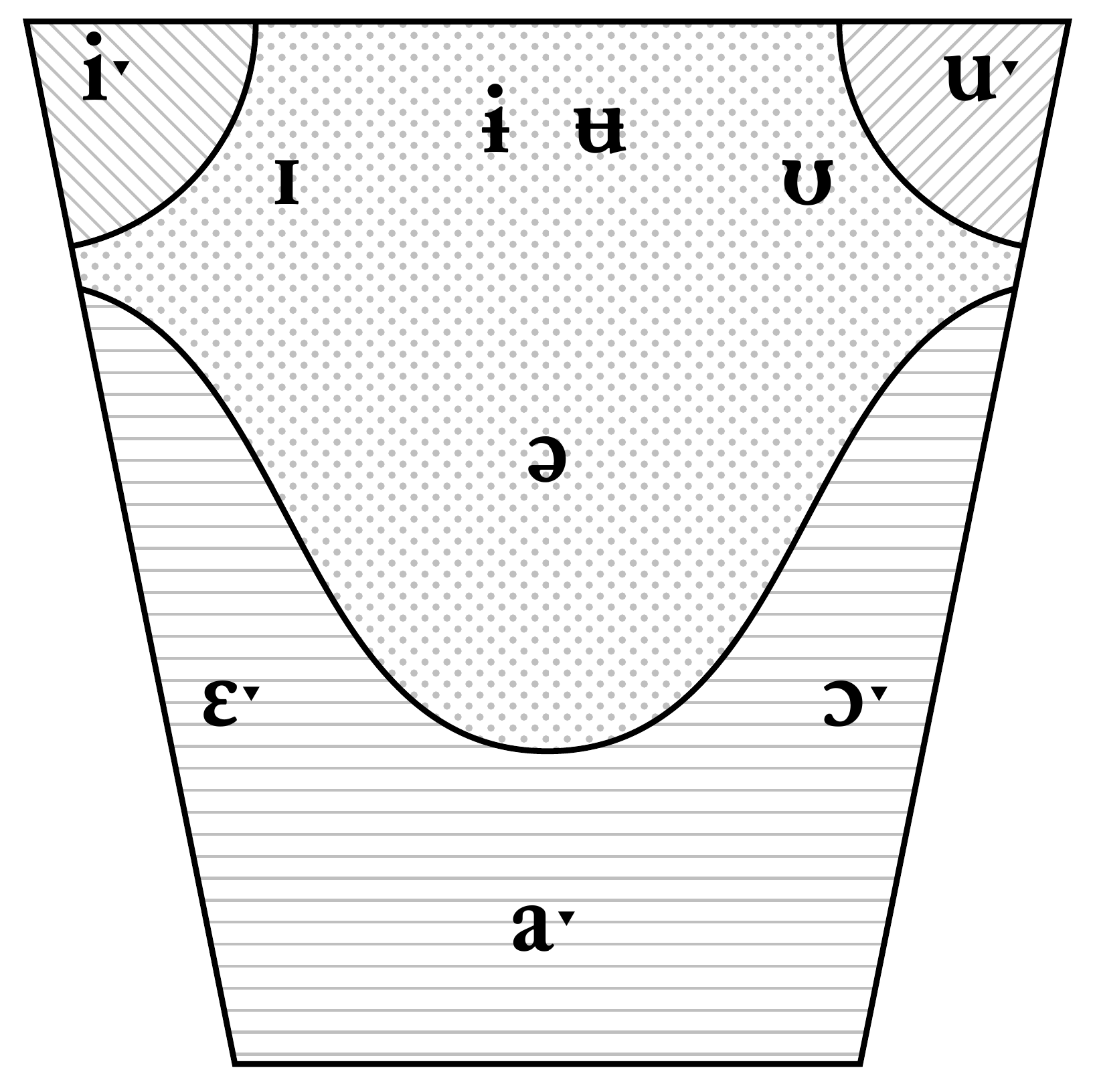
| A | aˑ | ɛˑ | ɔˑ |
| ə | ɪ, ɨ, ə, ʉ, ʊ | ||
| (ə)ɻ(ə) | ɪɚ(ɻ), ɚˑ(ɻ), ʊɚ(ɻ) | ||
| (ə)j(ə) | iˑ | ||
| (ə)w(ə) | uˑ | ||
If we treat the rhoticised off-glides as the realisation of /ɻ/ and control for the prosody of the phonological word, and consider the contrastive areas of the vowel space, we get the division shown in figure figure. In words of any prosody, these four regions are contrastive.
Phonological Domains
The key domains above individual phonemes are the syllable (σ), the phonological word (ω), and the phonological phrase (φ).
The Syllable
The syllable in Dirnang is a basic unit of organisation. Words are composed of one or more syllables, which have the typical structure CV(C), although onsetless syllables V(C) are permitted word-initially, and, due to final vowel loss, (C)V(C)(C) is permitted in the word-final syllable. Syllables are the bearers of stress.
Feet
There is little evidence for the significance of feet in Dirnang. A phonological word bears at most one stress, on the final syllable containing a low vowel. There is no evidence of additional rhythmic secondary stress, nor are there any phonological processes sensitive to foot structure.
The Phonological Word
Words are the minimal stress domain, although not all words are stressed. Within a word, at most one syllable may be stressed, and the location of that stress is predictable from the underlying form of the word. Special constraints apply to the edges of words: some consonants may not begin a word, only the first syllable of a word may be onsetless, and only the final syllable may contain a complex two-member coda.
Additionally, the word is the domain for two forms of harmony. The first is long-distance root-controlled vowel harmony (“prosody”) affecting the low vowels. These harmony rules apply to both prefixes and suffixes. The second is local spreading of the feature [+round] over compatible segments.
The Phonological Phrase
Phrases in Dirnang are somewhat word-like, within limits. Phrases do not show obligatory low vowel harmony or rounding spread, which is restricted to words. However, phrases license the expression of stress. While words are the minimal stress domain, only the final accentable word in a phrase receives primary stress. This assignment of stress may have implications for the form of the word, since frequently unstressed words tend to undergo vowel reduction and evolve into prefixes or compounded elements, while placement of stress may induce low vowel insertion in words that lack an acceptable host.
The likelihood of prosodic reduction in non-final elements is complex and influenced by information structure. Elements whose informational contribution aligns with right-edge prosodic prominence (e.g. generic elements, classificatory nouns, incorporated adpositions) are less likely to resist reduction, while elements whose informational contribution is misaligned are less likely to undergo irregular reduction.
In addition to phrasal stress subordination, external sandhi rules insert a schwa at the phrase-medial ω–ω boundaries, where clusters would otherwise result that would be impermissible word-internally. This process of schwa insertion preserves word-final contrasts and cues to consonant manner and place, many of which are borne by adjacent vowels. In phrase-final position, non-apical obstruents are released, which may be perceived as a short vocoid [ə̥̆]. Similarly, phrase-final clusters require a final vocoid regardless of the final consonant.
There is thus a blurry line between the phrase, the compound word, and the inflected or derived word. This blurring reflects the fact that some of the same phonological processes apply across these domains, differing primarily in strength rather than in nature or structure.
Phonological Word Structure
A critical feature of Dirnang word structure is that a number of harmony processes reduce the functional load of individual vowels, and of some individual consonant properties, namely rounding and, to a much more limited extent, retroflexion. The low vowels, which are arguably the only vowels present in the underlying representations, are harmonised and therefore only contrast in placement once the word prosody is known, not in quality. Of the other vowels, by far the most common, the schwa, is both short and shows strong coarticulatory effects with neighbouring consonants. The table below summarises these processes.
| Harmonic Process | Domain | Direction | Source | Target | Blockers |
|---|---|---|---|---|---|
| Low Vowel Prosody | word | bidirectional | root, word prosody | low vowels | none |
| Rounding Harmony | contiguous | bidirectional | uˑ, ɔˑ, rounded Cs | peripherals, retroflexes, ə | aˑ, ɛˑ, iˑ, alveolars, palatals |
| Retroflexion Spread | VC(C) | bidirectional | retroflex consonant | preceding vowels, following apicals | non-apicals |
| Palatal Spread | CC, iˑCC, iˑC# | bidirectional | iˑ, following palatal | coda n or l | none |
Low Vowel Prosodies
Every stressed phonological word carries one of three prosodies, namely a-prosody, e-prosody, or o-prosody, which are named after, and defined by, the quality of the low vowels /A/ in the phonological word. The prosody of unstressed words is not always determinable, since some unstressed words only contain /ə/. The impact of each prosody on the low vowel /A/ is described in this section. Additionally, low vowels in o-prosody words feed rounding harmony, and trigger the rounding of many or all of the peripheral consonants within the word. Apart from the spreading of rounding from vowels to consonants, prosodies are not predictable from the consonants present in the root.
In addition to rounding harmony, there are also some weaker associations that are not active phonological rules. Retroflex apicals are more frequent in o-prosody roots, although there is no active rule that triggers alternation between the apical series.
Default Prosody Assignment
Some words lack any underlying low vowels, but nevertheless have a prosody that becomes visible due to stressed vowel insertion, as described in the stress section, or due to prosody spreading into preceding clitics. Almost all of these words show predictable prosody based on the rounding of consonants which are adjacent to the default stress location. If any stress-adjacent consonants are rounded, with the exception of initial /w/, the word will surface with o-prosody, otherwise it will take a-prosody. There is no regular rule which assigns e-prosody to a form lacking underlying harmonic hosts.
Rounding Harmony
Rounding harmony can be characterised in terms of rounding sources, targets, and blockers. The sources are all underlying rounded segments, including the rounded low vowel /ɔˑ/ in o-prosody words, /w/ and its vocalic allophone [u], and rounded peripherals. The only exception amongst the peripherals is /ŋ/, which may be a target for rounding but cannot create a rounding domain. There is no contrastive phoneme */ŋʷ/.
The spread of rounding is bidirectional, and the targets of rounding are any peripheral, including /ŋ/, as well as any retroflex, and any /ə/ between rounded segments. In any stretch of peripherals and retroflexes separated only by schwas, either all are rounded or none are. These domains are bounded by either a word break or a blocking segment, namely an unrounded low vowel or a palatal or alveolar consonant.
While rounding is the feature actively spreading, this process can be more insightfully analysed by considering the phonological rule +rounded → +retracted, which applies to both vowels and consonants. All blocking segments bear the feature -retracted, whereas all targets are either +retracted or underlyingly unmarked for retraction (the bilabials). Rounding spread therefore amounts to expanding the rounding domain from a phoneme marked for rounding, until either a word boundary or a phoneme incompatible with the specification +rounded +retracted is reached.
The net effect of these rules is to extend rounding across much of o-prosody words, since any low vowel in such a word acts as a source of rounding, although islands may still be created where non-retroflex coronals block the spread. This makes rounding the dominant feature in the harmony system, since although fronting (e-)harmony has its harmonic segments, namely the palatals, the influence of the palatals is limited to adjacent vowels. They cannot create an unbounded fronting domain, and neither can low front vowels.
Distribution of Consonants
The structure of the word and distribution of consonants can be presented in two different ways. One way is to centre the syllable, and say that initial syllables have the structure (C₁)V(C₂), medial syllables have the structure C₄V(C₂), and final syllables have the structure C₄V(C₄) or C₄VC₂C₃. Monosyllables combine the initial and final structures and may be (C₁)V(C₄) or (C₁)VC₂C₃. V here represents any vowel, including both lexical vowels and epenthetic schwas, and the table below summarises the possible values of C₁…C₄.
However, the syllabic formulation hides a very important feature of word structure, which is that only intervocalic and final singleton positions permit all consonants, and syllables following a consonant have a more restricted range of onsets. When a consonant follows another consonant, only the smaller set C₃ is possible, and the sequence C₂C₃ is then subject to additional place and manner constraints.
A more accurate template, which captures the dependencies between adjacent syllables, states that every non-initial consonant position is occupied either by a single consonant C₄ or by a cluster C₂C₃. This produces a regular expression template (C₁)?V((C₄ | C₂C₃) V)*(C₄ | C₂C₃)?, i.e. an optional initial consonant, followed by one or more sequences of either V(C₄) or V(C₂C₃), with no vowel hiatus.
| Position | Place restrictions | Manner restrictions | |
|---|---|---|---|
| C₁ | Word-initial | No retroflexes | No rhotics or laterals |
| C₄ | Intervocalic, word-final after a vowel | – | – |
| C₂ | Before another consonant | Equal or higher ranking on apical > laminal > velar > bilabial | Equal or higher sonority than C₃, no glides except ɻ |
| C₃ | After another consonant | Apical clusters must agree in place | Obstruents, nasals |
The general constraints, and the fact that intervocalic and word-final position C₄ is the point of maximum contrast, is broadly in line with the phonotactics of Australian languages, as described in (Hamilton 1996) and (Baker and Harvey 2025). This is because C₄ makes both leading and lagging cues perceptible.
C₁ and C₃ both exclude places and manners which depend on preceding cues. They are very similar in many respects, although not identical, since glides occur in word-initial position but not in internal clusters. In other cases, the greater range of C₃ is more apparent than real, since while retroflexes may occur in C₃, they are not distinctive in that position and only occur if the preceding consonant is also retroflex.
C₂ and the C₂C₃ combination are tightly constrained by cue-driven hierarchies. To a first approximation, a given cluster is only permissible if C₂ matches or outranks C₃ on the following hierarchies:
- The Place Hierarchy
-
retroflex > alveolar > laminal > velar > bilabial
- The Sonority Hierarchy
-
laterals, rhotics > nasals > obstruents
The acceptability of equality depends on the scale. Equal place is generally acceptable in clusters, but equal sonority clusters are restricted to nasal-nasal and obstruent-obstruent clusters, and those equal sonority clusters only occur in intervocalic position, not word-finally.
Apical Assimilation
Amongst the coronals, the alveolars act as the least marked place, and are prone to place assimilation as a consequence.
Progressive Spread of Retroflexion
Since retroflexes and alveolars are primarily distinguished by their impact on preceding vowels, when a cluster of a retroflex and an alveolar consonant occurs, the alveolar assimilates in place to the retroflex. If the preceding retroflex is /ɻ/, it merges with the following alveolar to form a single retroflex consonant.
Regressive Laminal Spread
When an alveolar nasal or lateral precedes a palatal consonant, it assimilates completely in place. Additionally, when an alveolar nasal or lateral is preceded by [i] (due to an underlying /j/), the alveolar-palatal distinction is neutralised.
Complete Assimilation of Apical Stops
Due to its lack of release in coda position, the apical alveolar stop /t/ has a tendency to completely assimilate to a following stop in clusters. Historical or morphological clusters like /tk/ are produced as [kː] in casual speech. The retroflex stop is more complex: it is also unreleased, but the preceding vowel rhotacisation is never lost. Thus a phonological sequence /əʈk/ may also be produced as [ɚkː].
The Sonority and Reduction of Prenasalised Stops
As contour segments, prenasalised stops show mixed behaviour on the sonority scale. On the right edge, they pattern as stops, and therefore may only be followed by other stops. On the left edge, however, while they pattern similarly to nasals, they do not pattern identically. Laterals and rhotics may precede prenasalised stops, but other nasals may not, even though nasal-nasal clusters are permitted. This is likely because a sequence like */ɳⁿg/ differs from /ɳk/ primarily in having a short medial nasal segment with no CV or VC transition, which is somewhat hard to detect, and a shorter oral segment.
Before other stops, prenasalised apical stops show the same assimilatory behaviour that other apical stops show. Due to a lack of release, a sequence such as /ⁿdk/ would be [n͜t̚k], but the medial oral closure lacks significant place cues independently of the preceding and following material. The medial stop is reduced solely to a period of complete oral closure. Therefore, the sequence is typically reduced to [nkː] or [nk], thereby neutralising the distinction with the equivalent heterorganic nasal+stop sequences. This reduction does not occur with laminal or peripheral prenasalised stops in clusters like /ⁿɟk/, although some degree of regressive voicing assimilation typically occurs to give [ⁿck].
Nasal-Stop Clusters
In Dirnang, there is no distinction, at least within the base forms of morphemes, between prenasalised stops and homorganic nasal+stop sequences. When morpheme boundaries or schwa deletion brings together a homorganic nasal and stop, the result may be represented orthographically as two phonemes, and may be longer than an underlying prenasalised stop, although even in this case coalescence into a single segment is common.
Unlike in many languages, Dirnang is very tolerant of heterorganic nasal+stop clusters, although they are clearly more marked than prenasalised stops. Since they are clusters, they occupy two timing slots, and the stop typically remains voiceless. By comparison with the relatively short duration of prenasalised homorganic sequences, the stop in a sequence like /nk/ may be perceived as long [nkː]. In cases involving apical nasals specifically, this produces a neutralisation between nasal+obstruent and prenasalised stop+obstruent, except in very careful speech.
Trapped Glides
As described elsewhere, the glides /j/ and /w/ surface as phonetic high vowels between two consonants. But distributionally, such medial clusters are not common. Since glides are weak except when on the edge of a word or when adjacent to /A/, trapped glides rarely occur lexically, and tend to be reduced to schwas. In the case of /w/ especially, the only sign that such a glide was present post-reduction is rounding of adjacent peripheral consonants. Trapped glides generated morphologically by the addition of suffixes and clitics are more resilient, and retain their quality by default.
Intramorphemic Geminates
As described above, certain consonant clusters produce long consonants in the modern language, but historically, Dirnang lacked morphemes with underlying geminates. Most frequently, long consonants are false geminates which arise from schwa deletion, or from contact at morpheme boundaries.
Rounding Harmony
As described in this section, rounding spreads between adjacent peripheral consonants. This means that while clusters like /kp/ and /kʷpʷ/ are possible, there are no clusters of the form */kʷp/ or */kpʷ/.
Cluster Frequency and Markedness
Leaving aside the prenasalised stops and the retroflexes, which are analysed as single segments, the preferred cluster type in Dirnang is an apical sonorant followed by a peripheral obstruent. This combination maximises the distance along both the place and sonority hierarchies. Somewhat less preferred are identical or adjacent place clusters (apical-apical, apical-laminal, laminal-velar, …) and sonorant-sonorant or obstruent-obstruent clusters, and the combination of both (such as /ɳɲ/) is most marked. It might seem odd that homorganic clusters are somewhat dispreferred given that prenasalised stops are extremely common, but this reflects the distinction described in this section between monogestural complex segments and complex sequencing of gestures at the same place of articulation.
| Frequency | ||||||
|---|---|---|---|---|---|---|
| Places | High | ex. | Moderate | ex. | Low | ex. |
| ap-per | L-O, R-O, N-O, L-N, R-N, N-N | lk, rk, nk, lm, rm, nm | L-NO, R-NO | lⁿg, rⁿg | O-O, NO-O | tk, ⁿdk |
| lam-per | L-O | ʎk | N-O, O-O | ɲk, ck | N-N, L-N, L-NO, NO-O | ɲm, ʎm, ʎⁿg, ⁿɟk |
| per-per | N-O, N-N, O-O | ŋp, ŋm, kp | NO-O | ⁿgp | ||
| ap-lam | L-O, R-O, R-NO, N-O | ɭc, rc, rⁿɟ, ɳc | N-N, L-N, R-N, L-NO, O-O, NO-O | ɳɲ, ɭɲ, rɲ, ɭⁿɟ, tc, ⁿdc | ||
| lam-lam | L-O, L-N, L-NO | ʎc, ʎɲ, ʎⁿɟ | ||||
| ap-ap | L-O, L-N, L-NO | lt, ln, lⁿd | R-O, R-N, R-NO | rt, rn, rⁿd | ||
The Inventory of Intervocalic Clusters
The table below lists all permitted clusters, with clusters that are dubious, rare or restricted within the citation form of morphemes marked. These include complex segments (prenasalised stops), clusters whose surface forms show neutralisation (some apical O-O and NO-O clusters), and geminates arising from assimilation or morpheme boundary clusters.
| Places | N-O | ɻ-O, r-O | L-O | O-O | N-N | ɻ-N, r-N | L-N |
|---|---|---|---|---|---|---|---|
| ap+ap | ⁿd, ⁿɖ | (rt) | lt, ɭʈ | [tː], [ʈː] | [nː], [ɳː] | (rn) | ln, ɭɳ |
| ap+lam | ɳc | rc, ɻc | ɭc | (tc), (ʈc) | (ɳɲ) | (rɲ), (ɻɲ) | (ɭɲ) |
| ap+dor | nk(ʷ), ɳk(ʷ) | rk(ʷ), ɻk(ʷ) | lk(ʷ), ɭk(ʷ) | (tk(ʷ)), (ʈk(ʷ)) | nŋ, ɳŋ | rŋ, ɻŋ | lŋ, ɭŋ |
| ap+lab | np(ʷ), ɳp(ʷ) | rp(ʷ), ɻp(ʷ) | lp(ʷ), ɭp(ʷ) | (tp(ʷ)), (ʈp(ʷ)) | nm(ʷ), ɳm(ʷ) | rm(ʷ), ɻm(ʷ) | lm(ʷ), ɭm(ʷ) |
| lam+lam | ⁿɟ | ʎc | [cː] | [ɲː] | ʎɲ | ||
| lam+dor | ɲk(ʷ) | ʎk(ʷ) | ck(ʷ) | (ɲŋ) | (ʎŋ) | ||
| lam+lab | ɲp(ʷ) | ʎp(ʷ) | cp(ʷ) | ɲm(ʷ) | (ʎm(ʷ)) | ||
| dor+dor | ⁿg(ʷ) | [k(ʷ)ː] | [ŋː] | ||||
| dor+lab | ŋp(ʷ) | kp(ʷ) | ŋm(ʷ) | ||||
| lab+lab | ᵐb(ʷ) | [p(ʷ)ː] | [m(ʷ)ː] |
| Places | ɻ-NO, r-NO | L-NO | NO-O |
|---|---|---|---|
| ap+ap | (rⁿd), [ɻⁿɖ] | lⁿd, ɭⁿɖ | [ntː], [ɳʈː] |
| ap+lam | rⁿɟ, ɻⁿɟ | (ɭⁿɟ) | [ɳcː] |
| ap+dor | rⁿg(ʷ), ɻⁿg(ʷ) | lⁿg(ʷ), ɭⁿg(ʷ) | [nk(ʷ)ː], [ɳk(ʷ)ː] |
| ap+lab | rᵐb(ʷ), ɻᵐb(ʷ) | lᵐb(ʷ), ɭᵐb(ʷ) | [np(ʷ)ː], [ɳp(ʷ)ː] |
| lam+lam | ʎⁿɟ | [ɲcː] | |
| lam+dor | (ʎⁿg(ʷ)) | (ⁿɟk(ʷ)) | |
| lam+lab | (ʎᵐb(ʷ)) | (ⁿɟp(ʷ)) | |
| dor+dor | [ŋk(ʷ)ː] | ||
| dor+lab | (ⁿgp(ʷ)) | ||
| lab+lab | [mp(ʷ)ː] |
ap = apical; lam = laminal; dor = dorsal/velar; lab = labial; (ʷ) = with or without rounding.
N = nasal; O = plain obstruent; NO = prenasalised obstruent; L = lateral.
Complex segments are shaded; parentheses denote low frequency or a tendency to neutralise; square brackets denote surface assimilation or boundary clusters.
Realisation of the Glides
The glides have a very strong impact on /ə/, and this cannot be overruled by the word prosody. This influence especially applies to schwas before glides, which is consistent with the general preference for VC over CV vowel-consonant assimilatory processes. While /əj/ fully assimilates to the tense high vowel [iˑ(j)], word-initial / #jə/ may be more like [#jɪ]. /w/ shows similar behaviour.
This does not mean that the presence of /j/ or /w/ can force the word prosody to become an e-prosody or an o-prosody, but locally the glides may influence neighbouring consonants in a way contrary to the prosody which applies elsewhere. In a case where a consonant precedes /əj/ [i], the front vowel may act as a blocker to rounding spread and permit an unrounded consonant to precede. Similarly, /əw/ [u] triggers a rounding domain even in a-prosody or e-prosody words.
Since glides other than /ɻ/ are not allowed in consonant clusters at all, schwa insertion and the vocalisation of the high glides occurs whenever they would otherwise form a cluster with an adjacent consonant. This leaves word-initial before /A/, word-finally after /A/, and word-medially between two /A/ as the only contexts in which vowel colouring does not happen. The table below summarises their behaviour. Word medial sequences of the type C(ə)G(ə)C are also rare, since the glides tend to be lost or reduce to schwa and/or adjacent consonant rounding when trapped between two consonants.
A similar effect occurs with /ɻ/, although, as discussed above, this is more subtle because it both merges with following apicals and because rhoticisation is not directly associated with any prosody the way that fronting and rounding are. And because its affinity with coda position is so strong, it does not occur in absolute initial position without a preceding epenthetic schwa.
| Context | j Realisation | w Realisation | ɻ Realisation |
|---|---|---|---|
| #G(ə)C… | #jɪC… | #wʊC… | #ɚ(ɻ)C… |
| #GAC… | #jAC… | #wAC… | #ɚɻAC… |
| …C(ə)G(ə)C… | …CiˑC… | …CuˑC… | …Cɚˑ(ɻ)C… |
| …C(ə)GAC… | …CijAC… | …CuwAC… | …CɚɻAC… |
| …AGC… | …AjɪC… | …AwʊC… | …A(ɻ)C… |
| …AGA… | …AjA… | …AwA… | …AɻA… |
| …AG# | …Aj# | …Aw# | …Aɻ# |
| …CG# | …Cij# | …Cuw# | …Cɚɻ# |
Epenthesis
There is evidence that only /A/ and the glides are present in underlying representations, since given the locations of the low vowels, the placement of the schwas is predictable in order to produce a well-formed word. Epenthesis of /ə/ operates iteratively left to right, maximising legal clusters at each point, with a schwa inserted at the last possible internal point to repair an illegality. Schwas at the edge of the word are only allowed under limited conditions:
To repair a word consisting of a single consonant and form a valid CV syllable
To repair a word-initial rhotic, lateral, or retroflex consonant via addition of a prothetic vowel
After syllabification of individual words, to repair an impermissible cluster across word boundaries in a phrase
Permissibility here is positional. Clusters are not allowed at all in word-initial position, so if a word underlyingly begins in a sequence CC, a vowel must be inserted either initially or between the two, even if the CC cluster would be permitted intervocally. Final position is less constrained, but as described above, equal sonority clusters which would be permitted word medially are impermissible in final position, yielding additional epenthesis. The process naturally produces a maximal syllable structure of (C)V(C) non-finally, and (C)V(C)(C) finally.
There is some ambiguity about how epenthesis interacts with the glides /j/ and /w/. These do not form surface clusters with another consonant, which means they can only surface as consonants when adjacent to vowels and/or word boundaries. It is therefore assumed that epenthesis underlyingly inserts a schwa to separate a glide from a consonant. However, surface sequences like [jə], [əj] or [əjə] do not occur. As discussed in this section, the glides colour adjacent schwas, with the end result that a high vowel surfaces instead or as well in consonant adjacent positions.
Some simple examples of consonant sequences and the effect of epenthesis:
| Underlying | Surface | Note |
|---|---|---|
| ᵐb | ᵐbə | Need to form a minimal syllable overrides constraint against final schwa |
| kc | kəc | |
| anmk | anmək | Maximal two member cluster before epenthesis |
| prʈ | pərəʈ | *rʈ is not a valid cluster |
| nɻk | nəɻk | Word ends in a valid two-member cluster |
| mŋm | məŋəm | Equal sonority clusters are not tolerated in final position |
| ɻp | əɻp | Schwa prothesis occurs due to initial rhotic |
Stress and Stressed Vowel Lowering
Stress is important in Dirnang, but it is also highly restricted. Some words are prosodically deficient and may not bear stress, and even stressable words are only strongly stressed when they are the final such stress-bearing word in their phrase. This stress is realised by high pitch, increased intensity, and increased vowel duration. Non-final elements of phrases show stress weakening or loss, which may be paired with vowel reduction.
When a word does receive stress, this occurs on a single syllable, without any iterative secondary stress. The location of this stress is tightly coupled with vowel quality, since only underlying vowels (/A/ and its prosodic variants) may bear stress. Schwas and surface vowels derived from underlying glides cannot be stressed.
The stress rule is an unbounded last/first weight sensitive stress variant, in which only /A/ is heavy:
Stress the final underlying
/A/in the wordIf there is no such vowel, then insert a low vowel
/A/as a host in the first syllable, replacing the first schwa of the word.If a root without underlying
/A/has no prosody, assign a default prosody as described in this section.
For the most part, the process of stressed vowel insertion or lowering is straightforward, but it does produce alternations, including when a suffix containing /A/ is added to an underlyingly vowelless stem. In this case, the low vowel inserted by rule is lost, and the stress shifts rightward. It is important to reiterate that glides, even though they may create surface vowels, do not satisfy this requirement for a stressable vowel. Therefore, a consonant sequence like /c-n-j/, pronounced [cɪnij] when not stressed, can only have the stressed form [ˈcanij].
Release of Final Consonants and External Sandhi
Non-apical obstruents in phrase-final position are released, which may be perceived as a very short final schwa [ə̥̆]. This is necessary to preserve place cues, because otherwise distinctions like labialisation would be hard to perceive without a following vowel. Within phrases, a longer schwa is present between words as a form of external sandhi if, and only if, the sequence of consonants across the word boundary is both non-identical and does not constitute a valid word-internal cluster.
Orthography
The normal conventions to write the consonants are given in the first tablebelow , and somewhat align with the standard orthographic conventions for Australian languages. The vowels follow the spelling conventions in the second table. The most complex aspects of these conventions are the representation of the glides, the schwa, and of labialisation. These will be dealt with below.
| Manner | Peripheral | Coronal | |||||
|---|---|---|---|---|---|---|---|
| Bilabial | Velar | Apical | Laminal | ||||
| Plain | Rounded¹ | Plain | Rounded¹ | Alveolar | Retroflex | Palatal | |
| Voiceless Obstruent | p | pu, up | c | cu, uc | t | rt | ch |
| Prenasalised Obstruent | b | bu, ub | g | gu, ug | d | rd | gh |
| Nasal | m | mu, um | ng | n | rn | nh | |
| Lateral | l | rl | lh | ||||
| Rhotic | rr | ||||||
| Glide | û² | r | î³ | ||||
1 Because rounding spreads, its orthographic representation is complex. See Representation of Rounding and of the Schwa.
2 û represents both [w] and [uˑ]. See Representation of the Glides and Tense High Vowels.
3 î represents both [j] and [iˑ]. See Representation of the Glides and Tense High Vowels.
| Vowel | Spelling | Context |
|---|---|---|
| aˑ | a | A in a-prosody words |
| ɛˑ | e | A in e-prosody words |
| ɔˑ | o | A in o-prosody words |
| iˑ | î | Surface realisation of əj |
| uˑ | û | Surface realisation of əw |
| ə | i | Default spelling for schwa |
| u | When adjacent to a rounded phoneme |
Representation of Rounding and of the Schwa
Rounding and the schwa are tied together, because both use the letter u. The rules are:
In a round context, i.e. with an adjacent rounded consonant, write schwa as u
Otherwise, write schwa as i
Write rounding of a consonant before an unrounded full vowel (
/iˑ/,/aˑ/or/ɛˑ/) as CuVWrite rounding of a word-final consonant after an unrounded full vowel (
/iˑ/,/aˑ/or/ɛˑ/) as VuCWrite rounding of a word-final consonant after an unrounded consonant as VCuC
Schwa rounding is always written, but consonant rounding is only written if a consonant is contrastively rounded. Non-constrastive rounding targets like the retroflexes and /ŋ/ is never represented separately in the orthography.
These rules do not cause any confusion because vowel sequences do not occur, so u next to another vowel can only represent consonant rounding, and because of the spread of [+round], a rounded schwa means that any adjacent roundable consonant must also be rounded. Similarly, since schwas have predictable placement to break up impermissible clusters, a final sequence like -luc can only represent /lkʷ/.
Note in particular that this also means that rounding is not written at all adjacent to /ɔˑ/ or /uˑ/, because as rounded vowels, all adjacent roundable consonants must already be rounded. cob can only represent /kʷɔˑᵐbʷ/, and not /kɔˑᵐb/.
Representation of the Glides and Tense High Vowels
Given that syllabification and the realisation of the glides as consonants or high vowels is predictable, they are consistently written as î and û in all positions. Similarly, because of the strong colouring effect and the fact that neighbouring schwas assimilate to them, such schwas are not written. No word contains written sequences like iî or ûu.
It is important to point out that the representation of final rounding after front vowels as uC operates independently of these conventions. So, for example, a word-final sequence /-jəkʷ/ must be written îuc, whereas word-final /-jək/ would be -îc. Similarly, rounding written Cu before front vowels operates independently, giving cuî for /kʷiˑ/. While this system may seem unwieldy, the fact that the tense high vowels only arise as allophones of the glides means they are low frequency compared to /A/ and /ə/.
Initial Epenthetic Schwas
A number of consonants may be underlyingly word-initial, but due to constraints are removed from that position by schwa prothesis. Specifically, this is true of the laterals, the rhotics and the retroflexes. Before retroflexes, the initial schwa shows variable spelling as i or u depending on whether it is part of a rounding domain or not. Since the other coronals block rounding spread, an initial schwa before an alveolar or palatal is always written i.
The Repeated Digraph Rule
Sequences of two digraphs are simplified where this does not result in ambiguity:
When two retroflex consonants are adjacent, r only precedes the first. For example,
/ɭʈ/is written rlt./ɲ/and/ʎ/are written n and l before another palatal. For example,/ʎc/is written lch.When two rounded consonants are adjacent, only the second is followed by u. For example,
/kʷpʷ/is written cpu.
Examples
The table below gives some examples of how words are pronounced and the associated spelling. The pronunciations are given in IPA, and are more detailed than a standard phonemic representation. For example, sub-phonemic rounding or fronting of schwas based on neighbouring consonants is written, since it affects the spelling of the word in some cases. Similarly, allophonic, non-contrastive rounding of consonants is written.
| Pronunciation | Spelling | Pronunciation | Spelling |
|---|---|---|---|
| ⁿgaˑlaˑɲ | galanh | mʷʊⁿɖʷaˑɳ | murdarn |
| kʷɛˑnɛˑʎ | cuenelh | ⁿgʷuwɔˑn | gûon |
| ⁿɟɪɳɛˑɭ | ghirnerl | kɪʎɔˑŋʷ | cilhong |
| kʷʊŋʷʊⁿgʷɛˑ | cungugue | ŋʷʊpʷʊkʷɛˑ | ngupucue |
| ⁿɟaˑʈ | ghart | nɪnɛˑɻ | niner |
| cɪtɛˑmʷ | chiteum | waˑkʷaˑj | ûacuaî |
| təʈɛˑr | tirterr | daˑpʷaˑm | dapuam |
| wʊpʷɔˑⁿgʷ | ûpog | mʷʊtəlɔˑ | mutilo |
| mɪⁿɟijaˑ | mighîa | pɪɲɛˑk | pinhec |
| ⁿgʷʊᵐbʷʊrɛˑ | guburre | kəⁿɖaˑɲ | cirdanh |
| pətɪʎɛˑ | pitilhe | ⁿdʊkʷʊᵐbʷɔˑ | ducubo |
| məɭɛˑɳ | mirlern | mʷɪⁿɟəʈɛˑ | mughirte |
| mʷʊmʷɔˑw | mumoû | kətɪcɛˑ | citiche |
| tɪɲɛˑmʷ | tinheum | ⁿdəⁿgaˑm | digam |
References
- Silke Hamann (2003). The Phonetics and Phonology of Retroflexes. Utrecht University
- Baker, B.J. and Harvey, M. (2025). The Phonology and Morphology of Australian Languages. Cambridge University Press
- Wolff, H.E. (2022). A Historical Phonology of Central Chadic: Prosodies and Lexical Reconstruction. Cambridge University Press
- Gravina, Richard (2014). The phonology of Proto-Central Chadic: The reconstruction of the phonology and lexicon of Proto-Central Chadic, and the linguistic history of the Central Chadic languages. Leiden University https://scholarlypublications.universiteitleiden.nl/handle/1887/30139
- Philip James Hamilton (1996). Phonetic Constraints and Markedness in the Phonotactics of Australian Aboriginal Languages. University of Toronto
AI disclaimer: I wrote this text in LaTeX. ChatGPT was used to get convert this to WordPress format, to generate the feature image, and for general review and sense checking.


Leave a Reply