The previous chapter dealt with the phonology of words, but the accentual phrase is also an important phonological unit in Dirnang, characterised by final stress, non-final reduction, and sandhi-based schwa deletion.
The Domain
The domain of these processes is the accentual phrase (AP), which largely aligns with many smaller syntactic phrases. The preference tends to be for accentual phrases to be of short to moderate length, and long or deeply recursive structures are typically broken up into multiple such phrases. The following structures may show subordination of non-final stresses and concomitant reduction:
The integrated noun phrase, including:
article-noun
preposition-noun
noun-modifier
noun-possessor
The verb phrase, including:
tam-verb
verb-object
verb-complement
However, in many cases there is an alternative construction that does not involve combination into a single accentual phrase and reduction of the initial element(s), especially when those elements are lexical and not clitics or function words. Reduction tends to be incompatible with contrastive focus or strong information focus on the word in question, so the choice to join or split up elements is often motivated by information structure concerns.
Phonological Phrases, Syntactic Phrases, and Information Structure
In the terminology of (Jun 2005) and (Jun 2014), Dirnang is a head/edge prominent language. This means that prosody within the accentual phrase (AP) is determined by both marking of a prominent syllable of the phrase, and by AP boundary marking. As described in the section on the accentual phrase domain, the AP is often larger than an individual word, which in turn has consequences for the use of intonation for emphasis. Because stress serves an AP boundary marking function, Dirnang resists manipulation of suprasegmentals as a way to mark contrastive stress within a tightly bound phrase. Where an English speaker might contrast ‘the tall man’ and ‘the tall man’ to mark information structure contrasts with no surface changes to syntax or morphology, Dirnang tends to mark such distinctions by reorganisation of morphosyntactic phrases.
The core mechanism at work is the combined dissolution of both the accentual and syntactic phrase. Under default or neutral information structure conditions, syntactic phrases show strong phonological integration, and such integration can therefore be taken as a signal of typical information structure. Since Dirnang is right branching and stress is on the right edge of the phrase, default phonological emphasis also aligns with optional modifiers on the right edge conveying more contrastive information than initial elements.
When some non-final element of the phrase is under contrastive focus, the integrated construction can be abandoned for multiple independent APs, but in Dirnang many elements cannot stand alone. Nouns must form part of an NP headed by an article or preposition, and many modifiers (adjectives, coverbs) require a head. Because of the tight alignment of certain syntactic phrases and APs, dissolution may trigger restructuring of the separate elements into minimal independent morphosyntactic forms. For example:
In the example of phrase decomposition, emphasis on the noun has been achieved by separating the noun into its own phonological phrase, allowing it to have its own stress, and moving it to the right edge, which is the preferred location for focal material. However, bare nouns and adjectives are not good syntactic phrases in Dirnang. A common noun must normally incorporate into either a prepositional phrase, a determiner phrase, or a verb phrase. Therefore, the stressed element receives its own article, and the structure becomes the apposition of two complete noun phrases. An adjective must also be supported by a classifier or a copy of the head noun.
This aligned manipulation of syntactic and phrase structure is a core principle of Dirnang. Integrated, compound-like phrases, with minimal overt marking of internal syntactic or information structure and rigid internal order, express the unmarked case. The exceptional case, where a phrase becomes high complexity due to many foregrounded modifiers or internal contrastive focus, is marked by both phrasal and syntactic restructuring, to produce units with free ordering that permit overt structural marking and reduce contextual processing.
Stress Placement and Realisation
An accentual phrase in Dirnang consists of a sequence of elements which are either eligible or ineligible to bear the phrase accent. Stressable items consist of almost all content words. Unstressable items, which are often diagnosable clitics, tend to cluster at either the left or right edges of the phrase, with few permitted to occur phrase-medially (between stressable content words).
Within an integrated phrase, stress is placed on the rightmost stressable word. The placement of the stress within the word is determined by the rules described in the chapter on word-level phonology, but it is important to note that some words show vowel alternations due to stress. In the example of an integrated phrase, the unstressed form ngir corresponds to the stressed form ngor ‘dog’ in the example of phrase decomposition.
Stress is realised as a combination of high, rising or falling tone, increased intensity, and increased duration of the stressed vowel, as in the stressed forms ngor [ˈŋʷɔ̂ːɻ̥] and cardin [ˈkáˑⁿɖə̀nn̤]. Vowel lengthening is strongest when either the stressed vowel is in the final syllable of the AP, or to mark strong or contrastive focus.
Tone Contours
In addition to vowel length marking stress, an AP also shows a broadly predictable tonal contour, given its syllabification and the location of said stress. Using the revised ToBI notation (see (Jun 2014)), the typical accentual phrase tonal contour is (L+)H*La. This breaks down into a high tone (H*) target on the stressed syllable, preceded by a low tone (L+) at the beginning of that syllable or the end of the previous syllable, which produces a rising tonal contour on the stressed syllable. The preceding low tone may be dropped if the accent falls on the initial syllable of the AP. On the right boundary of the AP, in the final syllable, there is a low boundary tone (La) by default, which may be overridden by intonational phrase (IP) level boundary tones.
There is a split in the behaviour of other syllables in the AP. Syllables preceding the L+H* accent are toneless. Their tone is an interpolation, which is typically low because they are trapped between the La end tone of the preceding AP and the low starting point of the L+H* contour. However, in phrase initial position, with no preceding tone to start from, a stretch of toneless syllables may start from a mid tone and then drift downwards towards the pre-stress L. Non-final syllables after the stress, on the other hand, show high tone spreading rightward from the H* accent, blocked only by the La boundary tone. This produces a classic L-H-L ‘hat’ shape. The Accentual Phrase Tonal Contour diagram gives a graphical representation of the autosegmental tiers.
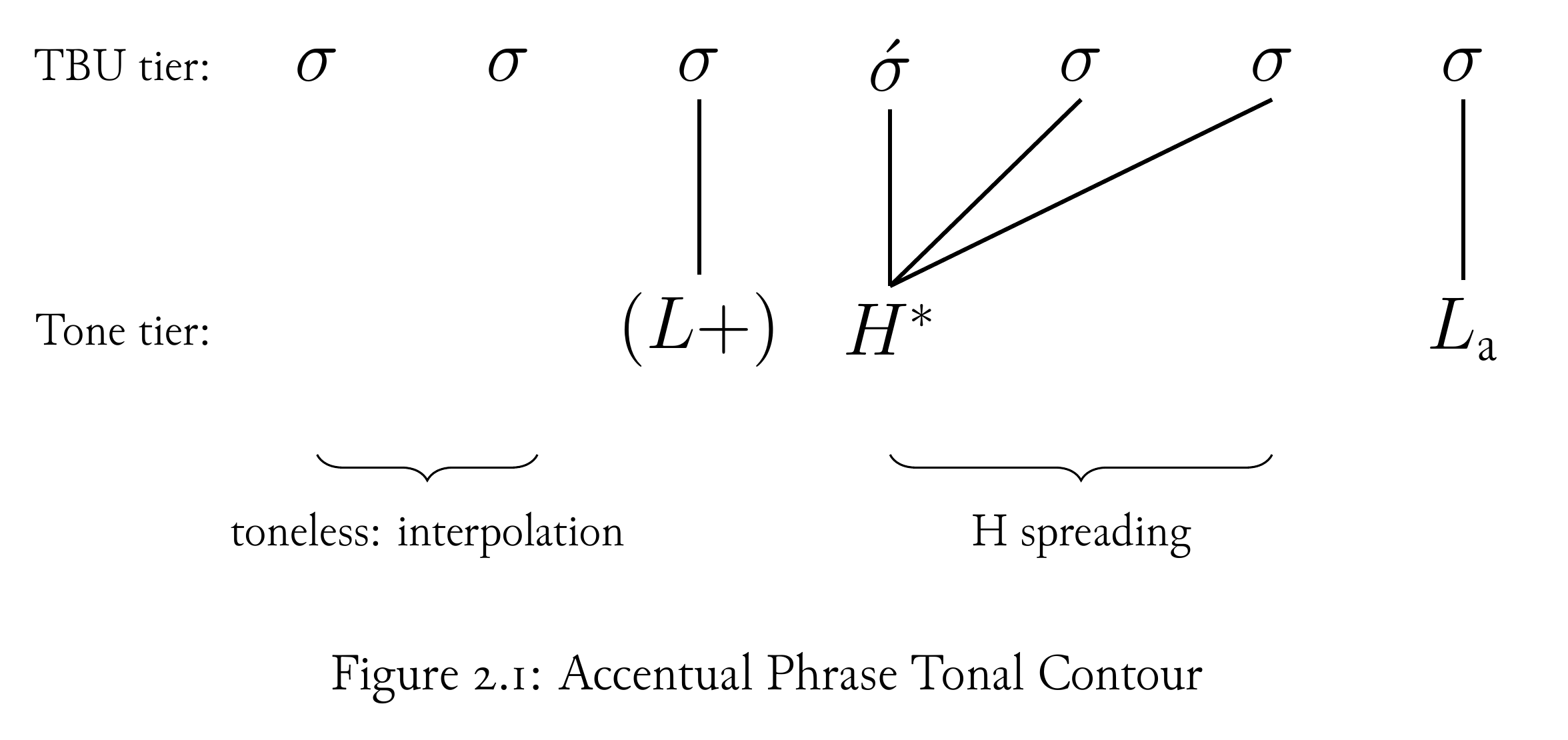
It is worth noting what happens when the accent aligns with the edge of the AP. When it aligns with the left edge, the pre-stress (L+) is dropped, producing a HH…L tone sequence. When it aligns with the right edge, both the H* and the La boundary tone associate to the same syllable, creating a HL fall on that syllable. When this occurs, the final vowel tends to be longer than a non-final stressed vowel, potentially to give additional space for the more complex syllabic tonal contour. And when the AP is monosyllabic, which is rare, both initial L dropping and H* + La coalescence occur.
Let us now consider some simple cases. The following examples show how the tonal contour shifts as the H* accent is shifted further from the right boundary.
| phrase | tone sequence | pronunciation |
|---|---|---|
| pi cuan | L H*+La | pʷʊ̀ kʷâːnn̤ |
| pi cardin | L H* La | pə̀ káˑⁿɖə̀nn̤ |
| pi cardin ghe | L H* H La | pə̀ káˑⁿɖə́n ⁿɟɛ̀ɦ |
AP Final Glottal Spreading and Neutralisation
One notable feature of Dirnang phrases is final glottal spread, which targets the end of the accentual phrase. All segments show spreading effects in this position, although the realisation depends on the nature of the phrase-final segment. Since most final stops are strongly released or followed by a short schwa-like voicoid to preserve their place cues, glottal spreading associates with that vocoid and the release to produce an aspiration-like effect. Sonorants and vowels show breathy voicing or some degree of devoicing, which may be perceived as a final [ɦ] if the syllable is otherwise open. This breathiness may be linked to the default low boundary tone of APs, given the recurring typological association between spread glottis and tone lowering.
| Class | Realisation | Example |
|---|---|---|
| Voiceless non-apical stop | Aspiration, strong release | k → kʰ |
| Voiceless apical stop | Unreleased | t → t̚ |
| Prenasalised non-apical stop | Devoicing of oral segment | ⁿg → ⁿk(ʰ) |
| Prenasalised apical stop | Devoicing of oral segment, unreleased | ⁿd → ⁿt̚ |
| Nasal | Lengthening, breathiness of second half | n → n͡n̤ |
| Liquid | Devoicing | l → l̥ |
| Semivowels (high vowels) | Final devoicing, breathy voiced offglide | i ~ɪj → iɦ ~ɪj̥ ~ɪç |
| Low vowels | Breathy voiced offglide | a → aɦ |
One outlier in this process is segments which end in an apical oral stop, including both voiceless apical stops and prenasalised apicals. These are the least marked stop codas by place, and as in internal coda position, they are consistently weakly released or unreleased in final position. This means that the final breathiness has no detectable effect on such segments. It also means that prenasalised apical stops are especially weak in final position. Since the unreleased oral phase of the prenasalised contour is hard to detect when nothing follows, a final apical prenasalised stop like ⁿd → ⁿt̚ [n̆t̚ ] differs from a final apical nasal n → n͡n̤ in the duration of the nasal phase, which is shorter for the prenasalised stop, and the lack of breathy voicing in that nasal phase. This effect is subtle, and therefore prenasalised apical stops and nasals tend to be neutralised in phrase-final position.
Unstressed Reduction in the AP
While an AP is not a word, it does show signs of phonological integration beyond being the domain for stress. In addition to tonal and durational changes when stress is lost, many non-final elements show additional segmental changes. The most frequent change is loss of an initial syllable /A/ that was inserted solely to bear stress, as described in the section on stress and stressed vowel lowering in the previous chapter. Other vowels and glides may show irregular reduction in frequent forms, with concomitant changes due to rounding spread. The Non-Final Word Reduction Processes table summarises the typical reduction processes.
| Reduction Process | Predictability and Conditions |
|---|---|
| Reduction of initial syllable A | Common but unpredictable, depends on underlying form |
| Reduction of non-initial syllable A | Unpredictable, irregular |
| Further spread of consonant rounding | Predictable from consonants and vowel qualities in reduced form |
| Reduction of glides and surface high vowels | Intermittent, common when glides are trapped word internally |
| Other irregular changes | Unpredictable, mostly for high frequency forms evolving into prefixes |
Sandhi and Schwa-Insertion
Within the word, as described in the word-level phonology chapter, schwa placement is driven by syllable structure and permissible cluster constraints, and therefore predictable. While a wider range of clusters across word boundaries may be tolerated in rapid speech, in careful speech, a schwa is inserted between words if the cluster that would otherwise be formed across the word-boundary is impermissible word-internally.
This process is more limited than word-internal epenthesis and vowel shifts. Within the word, schwas are freely placed to generate optimal syllable structure. When a sequence of words is concatenated into a phrase, a new schwa may not be inserted into already syllabified material. The phrase in Dirnang, although it is more word-like than in most other languages, is not a word, and shows evidence of layered or cyclic rule application.
While schwas may not be inserted into already syllabified material, they may optionally be deleted if the phrasal environment renders an internal schwa unnecessary. More specifically, word-internal schwas may be deleted due to the following syllabification constraints being relaxed in context:
The lack of initial CC clusters
Since there are no initial CC clusters, a schwa must be inserted to break up such an underlying cluster. But if a preceding word ends in either
/A/or a consonant which triggers insertion of a schwa at the word boundary, this schwa may be deleted. For example, when the article pi/pə/is added to nipan/nəˈpaˑn/, the result is pi nipan/pənˈpaˑn/.The prohibition on final equal sonority clusters
Equal sonority clusters which are tolerated intervocalically are not permitted in word-final position. When a following vowel is available, a final schwa may then be deleted. Consider chornum
/cɔɳəmʷ/and tak/ˈtaˑk/. When combined to give chornum tak, the result is/cɔɳmʷəˈtaˑk/.
Additionally, when vowel hiatus occurs over a word boundary and one of those vowels is a schwa, that schwa is deleted to resolve the hiatus. As the examples above show, neither schwa deletion nor boundary schwa insertion are written. The deletion of schwas is normally not written either, with the exception of certain function words.
Special Clitic Phonology
Definition of a Clitic
Before we can discuss their behaviour, we must first define clitics. Dirnang has both proclitics and enclitics, but the diagnostic criteria for these categories are somewhat different. Enclitics are defined by a single criterion: their inability to attract the AP’s accent, which is instead retained by the last non-clitic within the AP. Otherwise, enclitics remain word-like. They may have their own vowel prosody, and resist assimilatory processes like rounding spread.
The pressure to reduce is much stronger in the pre-accentual phase of the AP. In this domain, accent is less useful as a diagnostic criterion, because non-final non-clitics also lack stress. If a word always occurs at the beginning of a multi-word syntactic phrase due to its function, it is impossible to determine whether it is lexically marked as unaccentable or not. Without further signs of phonological dependency on a following word, one can make the analytical choice to classify all, some or no phrase-initial function words as clitics. However, some elements have a stronger claim to proclitic status, due to the following properties:
- Insufficient word size
-
No independent word has the form C, Cə or əC. Articles, however, do have this shape.
- Rounding spread
-
Some small clitics show rounding when the following word begins with a rounded consonant.
- Prosody spread
-
Some clitics agree in vowel harmony class with their host.
This means there is a directional asymmetry in harmonic processes beyond the core word. Within a word, rounding spread and low vowel harmony are bidirectional, but with clitics, these processes, when they do occur, are strictly anticipatory.
Analysis
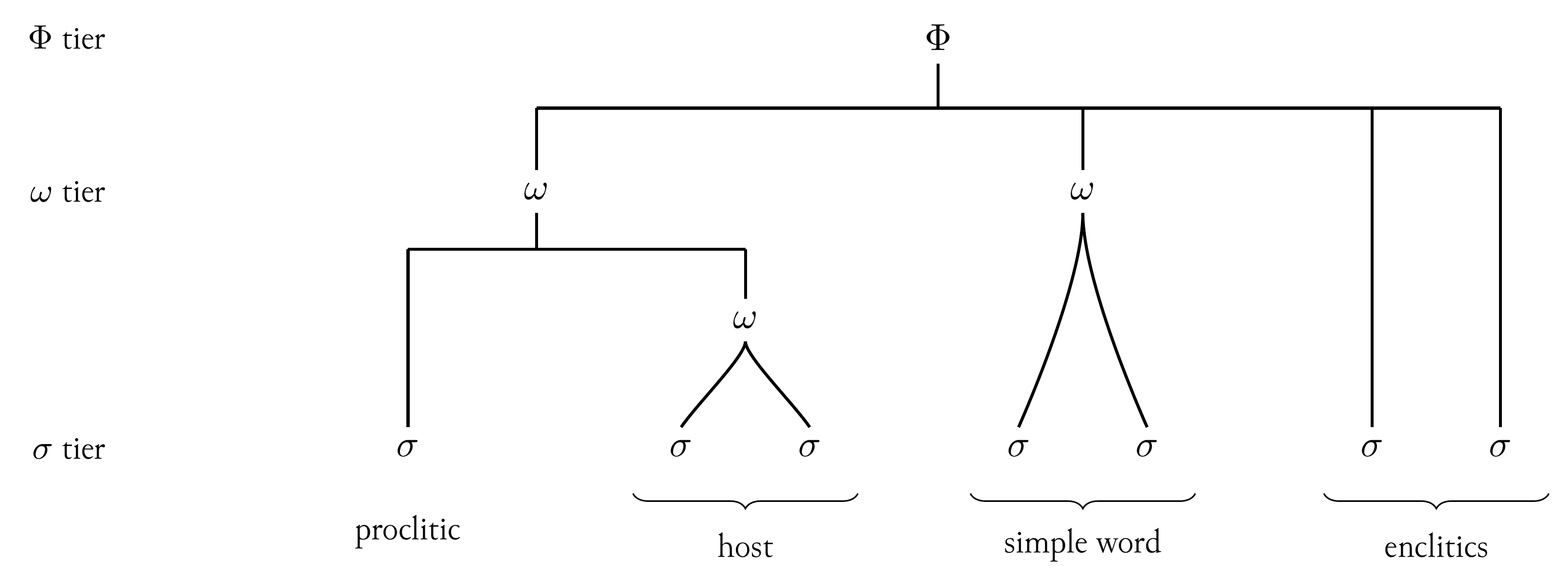
Given the distinct behaviour of enclitics and proclitics, it may be that they require different analyses. In (Mansfield 2020), Mansfield analyses Murrinhpatha PPhrases (phonological phrases that are the domain of a pitch accent) as consisting of PWords, which may host the accent, and prosodic adjuncts, morphological elements which are not part of a PWord, and may not host the accent. Mansfield also analyses some compounds as consisting of a recursive PWord.
These same two models may explain much about the behaviour of unaccentable material in Dirnang. Clitics which show no integration with their host may be adjoined at the AP level, whereas harmonising proclitics may be adjoined to a host word to form a larger, recursive PWord, with the host as the head. Potential proclitics which fail to harmonise are either AP adjoined, or not clitics at all. The following illustrates the structure, denoting APs as Φ and prosodic words as ω.
| independent words | [Φ [ωW] [ωW] …] |
| harmonising proclitic | [Φ [ωCL = [ωW]] …] |
| enclitic | [Φ [ωW] = CL] |
The Illustrative Structure of an AP diagram gives a more visual illustration of how, under this analysis, recursive ω and material outside the word may combine to form an AP.
Emphasis
An issue with the accentual deficiency of clitics is that they cannot be contrastively emphasized independently of their AP. Dissolution of the AP, which allows content words to be emphasized, cannot work for clitics by definition. This leaves three primary methods by which a clitic can receive emphasis.
Paraphrasing
The clitic can be replaced by an alternative construction which contains an accentable word. This strategy is not available to all clitics – for example, the article pi is not replaceable by a construction in much the same way that English ‘the’ cannot be truly substituted by a different word with no change in meaning. Since most enclitics are less structural than proclitics in strongly right branching Dirnang, enclitics tend to be easier to paraphrase.
Lengthening and Reduplication
The second strategy is also primarily available to enclitics. The stress accent is marked by a combination of rising or high pitch and increased vowel length. While the enclitic cannot shift the tone rise rightward or shorten the accented syllable, emphasis by vowel lengthening within the enclitic, or by enclitic reduplication, is possible.
For vowel lengthening to apply, the enclitic must contain a low vowel /A/, since Dirnang consistently shows a rule [+long] → [-raised] (see also the section on stress and stressed vowel lowering). An enclitic which lacks a low vowel may sometimes have a low vowel variant specifically to express additional contrast. Otherwise, reduplication is potentially available for emphasis for any enclitic.
Constructional Reinforcement
The final strategy is reinforcement by additional morphosyntactic material. The original clitic remains in place, but an additional element with overlapping or compatible semantic content is added elsewhere in the construction. This allows the relevant meaning to receive additional prominence without requiring the clitic itself to bear an independent accent. Often, the reinforcing element is phrase-final, creating a circumfixal pattern. This is the favoured strategy for most proclitics, which are often independently required for structural or expression type marking purposes.
Aberrant Clitics
The bound determiners /(ə)l/ and /(ə)n/ have an unusual shape. These clitics only occur AP medially, when the determiner is preceded by another noun, a verb or a preposition, and followed by its noun. Semantically, they associate right with their nominal, yet they consistently show a VC shape, unless the preceding word ends in a vowel or glide. Based on the standard rules of predictable schwa insertion, a more variable shape might be predicted, especially for the nasal phoneme /n/ which is not confined to post-vocalic position by those same syllabification rules. However, what is observed is a more predictable shape, likely due to the high frequency of these forms. The fact that schwa presence is only sensitive to the shape of preceding material is also weak evidence that these clitics are ditropic.
Intonational Phrases and Larger Units
The section on accentual phrase tone contours describes the tonal contour of a single AP, but APs combine in turn to form intonational phrases (IPs). The IP has its own tonal contour, formed by a combination of the relative heights of the AP L and H* tones, together with the final boundary tone on the right edge of the IP.
Downstep and Right Edge Focus
In neutral contexts, the H tones within an IP naturally drift downwards, giving an effect H*₁ > H*₂ > H*₃ > …. In the ToBI notation, this could be modelled with the downstep diacritic !, making the non-initial AP accent contour L+!H*. The main exception to this is when an AP within the IP is subject to contrastive focus, in which case the H tone on the accented syllable resets and even exceeds the initial pitch range, producing an ultra-high tone. Consistently with the right edge preference of Dirnang, this high tone cannot be freely placed on any AP, but is typically placed on the final AP, yielding a hockey stick contour H₁ > H₂ > H₃ ≪ ↑H₄, where ↑ represents a pitch range reset and expansion. If the AP under contrastive focus is not already on the right edge, then morphosyntactic reordering is triggered to permit the required placement.
The other possible placement for the contrastive focus tone is on the first AP (↑H₁ ≫ H₂ > H*₃ > …), but this requires additional focus marking on that initial AP, such as a cleft construction marker. Attempts to place a contrastive focus tone on a medial AP are not easily accepted. As in many languages, the prominent positions are the edges of the relevant phonological and syntactic phrase.
Focal Vowel Lengthening
The contrastive ↑H* tone is often combined with expressive lengthening of the AP’s accented vowel, especially when the contrast is emphatic. Since the accented vowel must be low, it already complies with the rule [+long] → [-raised], and can freely be lengthened.
Right Boundary Tone Contours
As in many languages, the final tone contour of the intonational phrase correlates with the speech act and the intended effect. While the normal AP L+H*+La contour ends in a low tone, this may be overridden by the IP boundary tone. There are some subtleties to how the IP boundary tone is modulated, but the core opposition is between a final L%, which is indistinguishable from the typical La, and a marked final H%.
This opposition is somewhat similar to English. A final L% signals finality, and occurs in declarative clauses, commands, and final elements of sequences, including the final clause in a discourse sequence. Final H%, on the other hand, signals ‘openness’ in some sense, which covers questions, but also unfinished utterances, including non-final list elements and non-final clauses within a sentence. It is, however, somewhat false to claim that all of these cases show an identical tonal profile. The realisation of the IP boundary tone is gradient. While non-finality consistently shows tone raising, there is a distinction between the moderate raising present in unmarked list contexts, and much stronger final raising when a response is expected from the addressee, as in a question. These two cases could be distinguished as M% vs H%, or even H% vs ^H%, but even this analysis misses the fact that final H% is impressionistically subject to a wide degree of expressive variation.
Synthesis
Excluding the exact placement of the contrastive focus, the two factors above create the broadly two-dimensional IP contour typology shown in the IP Contour Typology table.
| IP Final Pitch Spectrum | |||
|---|---|---|---|
| Focal AP Accent | L% | → | H% |
| No | neutral declarative, imperative | medial clauses | polar question, uncertainty |
| Yes | contrastive focus declarative | wh-question | incredulity, echo question |
References
- Jun, Sun-Ah (2005). Prosodic Typology: The Phonology of Intonation and Phrasing. Oxford University Press 1
- Jun, Sun-Ah (2014). Prosodic Typology II: The Phonology of Intonation and Phrasing. Oxford University Press 2
- John Mansfield (2020). Murrinhpatha Morphology and Phonology. De Gruyter Mouton


Leave a Reply